The lead
FCC authorizes SpaceX to build up to 1 million Starmind satellites
The FCC approves SpaceX's Starmind constellation, Europa Clipper nears its Earth flyby, and Chang'e-6 samples shed light on the Moon's largest crater.
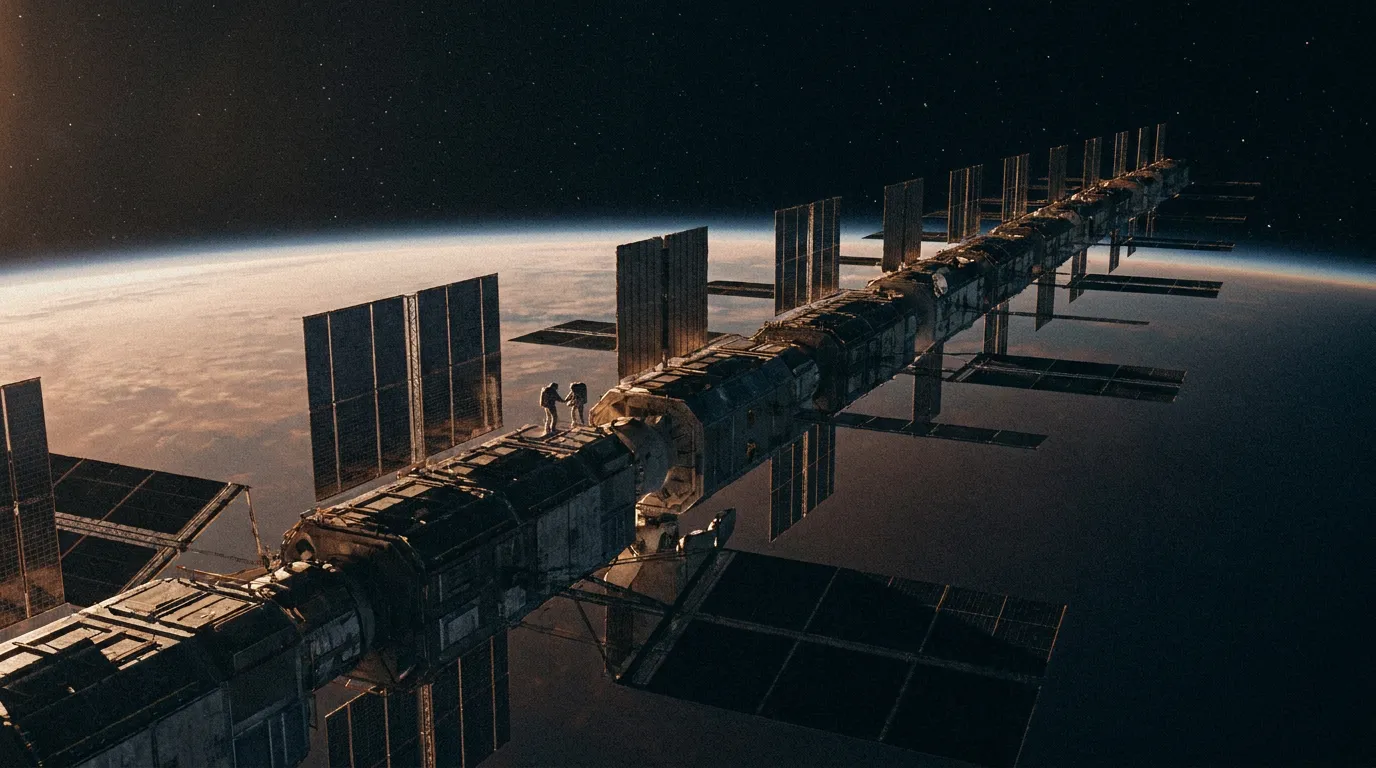
The Federal Communications Commission has authorized SpaceX to deploy up to 1 million Starmind satellites, built as orbital data centers for artificial intelligence computing. NASASpaceflight reports that the order, released on November 25, is the first U.S. authorization of its kind. SpaceX must have one operational satellite on station by November 25, 2033, 50 percent of the constellation deployed by 2038, and the full network by 2040, Spaceflight Now reports.
Elon Musk said he expects the first launch in the third quarter of 2027, with volume building after that. The satellites will send data back mainly over optical laser links to Starlink, and will fly in six shells between about 500 and 1,002 kilometers. For scale, NASASpaceflight cites a catalog counting roughly 17,200 active satellites, more than 11,100 of them Starlink. Phys.org reports that some scientists are skeptical and alarmed.
Sources: NASASpaceflight, Spaceflight Now, Phys.org
Road to Mars
Europa Clipper nears an Earth flyby to gain speed for Jupiter
NASA's Europa Clipper, launched in October 2024, has not yet left the inner Solar System. Universe Today reports that a gravity maneuver at Mars in March 2025 sent the spacecraft back toward Earth. In a few days it will use an Earth flyby to gain speed toward Jupiter and Europa. The encounter is also the last chance to calibrate its instruments before the long cruise.
Orbital data centers will need robots to maintain them
JPL physicist Slava Turyshev has published a follow-up study, available as an arXiv preprint, on keeping orbital data center hardware running once it is in space. Universe Today reports that launching the equipment is only half the problem, and argues that robots rather than astronauts will have to do the repairs.
Australia weighs the cost of flying its own astronaut
Australia is in talks with the European Space Agency about flying Katherine Bennell-Pegg on a future mission, Phys.org reports. She is director of space technology at the Australian Space Agency and finished ESA training in 2024. If accepted, she would be the first officially funded Australian astronaut. The article asks how to judge whether the expense is worth it.
SpaceNews podcast: Tim Marshall on a harder future in space
In a SpaceNews podcast episode, host Mike Gruss talks with journalist and author Tim Marshall. They discuss how the war in Ukraine served as a wakeup call for Europe, and what that means for life in space.
The Lab
Chang'e-6 samples trace how the Moon's largest crater formed
A new paper in Science Advances describes samples returned by China's Chang'e-6 mission from the South Pole-Aitken basin, one of the largest, oldest and deepest impact craters on the Moon. The authors combine them with in-situ data from Chang'e-4 and its rover to build a geological history of the major impacts that formed the basin, Universe Today reports.
Astronomers detect vaporized titanium oxide around a young star
Astronomers have detected titanium oxide as a gas for the first time around a young, massive star, Universe Today reports. The finding offers a rare look at the earliest stage of solar system formation, before planets and asteroids take shape.
Sound Money
Bitcoin developers debate how to handle large post-quantum signatures
A post on Delving Bitcoin examines how Bitcoin Core should handle large stack elements. The author says no post-quantum signature scheme except isogenies fits the current 520-byte limit. One proposal would raise it to 6kb in a new tapscript version. Larger elements raise denial-of-service risks, since scripts can hash and duplicate them. The author's pull request stores stack elements as reference-counted objects.
Coins dormant for 10 years are growing faster than new issuance
Bitcoin Magazine reports that miners produce about 450 new Bitcoin a day, while over the past year about 630 a day moved into wallets dormant for 10 years. Analyst Sean Hagan puts that at about 1.4 coins entering deep storage for each new coin mined. The group of coins held for ten years or more has reached a record 3.6M BTC.
Watch

Dr. Wilson Hago - 2026 Mars Society Conference, Day Two
The Mars Society · Nov 26, 2026

Michael Rudolph - 2026 Mars Society Conference, Day Two
The Mars Society · Nov 26, 2026

Bob Mills - 2026 Mars Society Conference, Day Two
The Mars Society · Nov 26, 2026
The Marscoin Ledger
Marscoin chain ran slightly short of its daily target
Marscoin produced 687 blocks in the last 24 hours against 702 expected. Five waits ran past 30 minutes, the longest 53 minutes. The price is $0.0609 per MARS. On the swap market, 14 offers are on the book, together offering 9,870 MARS. No new releases were reported.