The lead
SpaceX catches Ship 42 at Pad 2 as Booster 22 is lost offshore
Starship's ship catch, a Vulcan launch failure and a Curiosity drilling milestone, plus a Bitcoin Core fix and Marscoin's day on the chain.
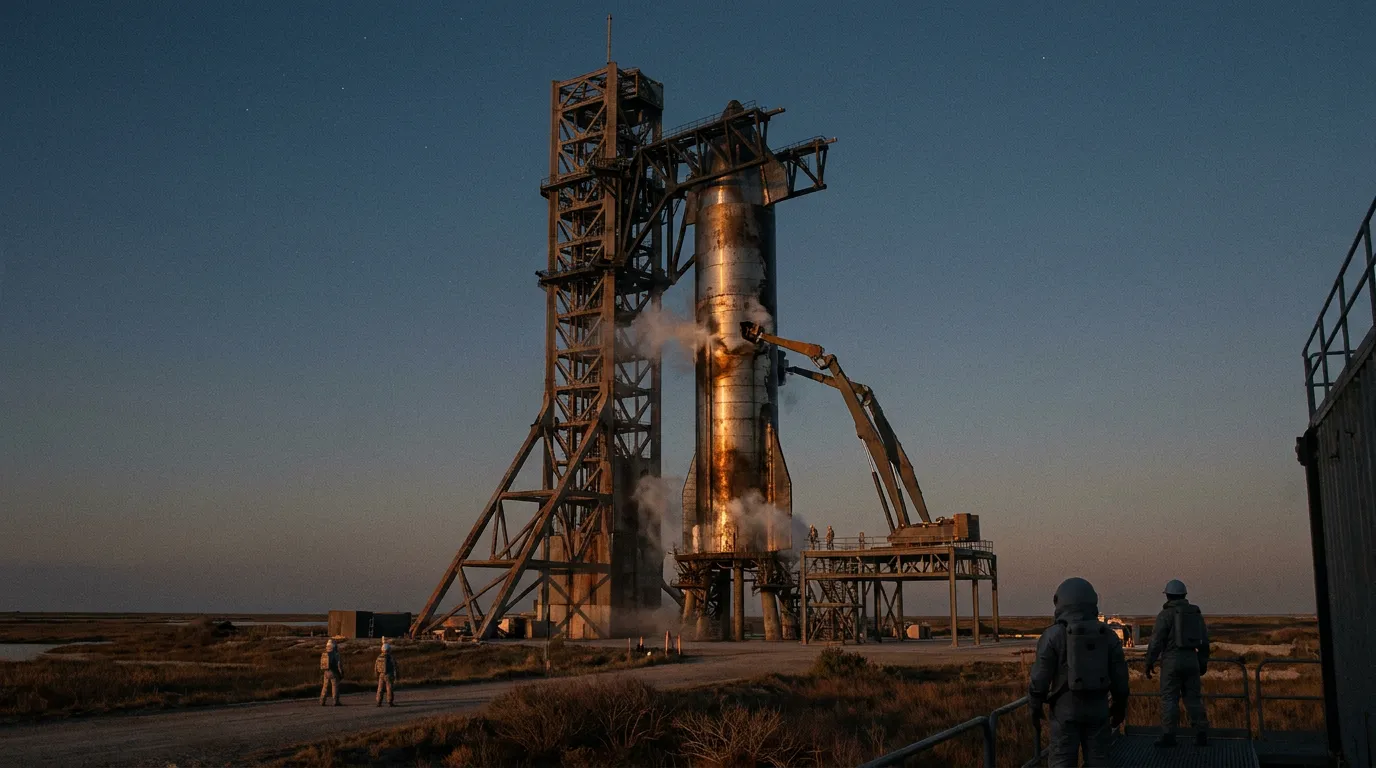
SpaceX caught Ship 42 with the tower at Pad 2 on Nov. 14, after the ship came back from space, NASASpaceflight reports. The site describes it as the first time anyone has recovered both stages of a rocket over its lifespan. Catching a returning ship at its launch site points toward the fast reuse that Mars flights will need.
The booster did not make it. Booster 22 and Ship 42 lifted off on Nov. 13, and all 33 engines ran through the ascent burn. After a 32-engine boostback burn, the booster called an automated offshore divert, finished its landing burn two miles offshore, and was destroyed by the flight termination system. The cause is unknown. Elon Musk wrote on X that the engines may have underperformed, then added that "initial conclusions are often wrong to some degree."
Source: NASASpaceflight
Road to Mars
Vulcan suffers a total launch failure as Starship ship is caught
Ars Technica's Rocket Report contrasts two US rocket makers. SpaceX caught its Starship upper stage at the pad in Texas, though the Super Heavy booster was lost at sea. United Launch Alliance had its first-ever total launch failure with Vulcan. Ars notes that the US Space Force and Amazon have booked some 70 launches on that rocket. Separately, ICEYE said it seeks to buy Avio for more than $2.2 billion.
Falcon 9 launches USSF-317 from Vandenberg for the Space Force
SpaceX launched an undisclosed number of satellites for the U.S. Space Force from Vandenberg on Nov. 21 UTC, Spaceflight Now reports. The mission, USSF-317, is the sixth in a series of "R" missions. Booster B1100 flew for the 11th time and landed on the droneship, the 679th Falcon booster landing to date. SpaceX plans at least two more Space Force launches before month's end.
Voyager 1 reaches one light-day away; Congress eyes more science funding
The Planetary Society's weekly roundup reports that Voyager 1 now looks back from a distance of one light-day. It also covers a congressional proposal to increase NASA science funding, and China's announcement of potential plans to land on a moon of Jupiter.
Curiosity's drill count reaches 49 holes
NASA released a collage dated Nov. 16 showing 49 drill holes made by the Curiosity rover as of November 2026. Each hole marks a rock sample. The drill on the rover's arm drops powdered rock into instruments inside the rover, which analyse its composition.
Why JPL's management is unusual, as the lab turns 90
In a Planetary Society conversation marking the Jet Propulsion Laboratory's 90th year, Casey Dreier, the society's chief of space policy, speaks with historian Peter Westwick. They discuss the unusual way in which the laboratory is managed.
The Lab
Chip-making methods may offer a way to pull oxygen from lunar soil
Researchers writing on Phys.org say their latest work links computer chip manufacturing with lunar exploration more closely than expected. They propose a new way to extract oxygen from lunar soil that could support bases on the moon.
Low-viscosity lavas shed light on Mars's past at Jezero
Phys.org reports on the Séítah formation in Jezero Crater, a nearly 4-billion-year-old rock layer at the crater's base. The Perseverance rover, roaming the crater since 2021, took close-up images of it. The article links low-viscosity lavas to what the formation reveals about Mars's past.
Sand grains could reveal wind speeds on other worlds
Universe Today reports on a paper in the Proceedings of the National Academy of Sciences by Stanford researchers. Scientists have long read dune size and orientation to find wind direction on worlds with atmospheres. The paper reports that dunes can also reveal how fast the wind blows, which orientation alone cannot show.
Sound Money
Bitcoin Core fixes a bug that let a peer stall nodes
Bitcoin Core disclosed on Nov. 20 a medium-severity flaw in which a peer could briefly stop a node from processing blocks and transactions. It repeated an orphan transaction announcement across a message of up to 50,000 entries. Fixes are in versions 30.5, 31.3 and 32.1. The 29.x series has reached end of life and will not be patched.
Researchers publish a 131-page security analysis of SHRINCS
Bitcoin Magazine reports that researchers released a 131-page analysis of SHRINCS, a proposed post-quantum signature scheme for Bitcoin, and asked others to look for flaws. It estimates classical security of 121.4 to 122.7 bits, resting on three unproven conjectures. Stateful signatures run from 548 to 4,619 bytes, against 64 bytes for Schnorr today.
Optech #432 covers decentralized mining pool payouts
Bitcoin Optech's newsletter summarizes an analysis of how decentralized mining pools can pay miners directly from coinbase transactions. It also describes the disclosure of a fixed denial-of-service vulnerability in Eclair and continued discussion on whether stale tip relay should include block data.
Watch

Red Planet Live -- 2026 Convention Recap
Red Planet Live · Nov 18, 2026

2026 Mars Society Convention - Day 3
The Mars Society · Oct 25, 2026

RedPlanetLive - David Brin, Ph.D.
Red Planet Live · Oct 14, 2026
The Marscoin Ledger
Marscoin chain ran slightly ahead of schedule, with nine long waits
Marscoin produced 713 blocks in the last 24 hours against 702 expected. Nine waits ran past 30 minutes, the longest 59 minutes, and there have been 59 such waits over seven days. The median gap between blocks was 8 seconds against a 123-second target. The price is $0.0604 per Marscoin.