The lead
Voyager 1 is now one light-day from Earth
Voyager 1 passes one light-day, Relativity fires a Terran R upper stage for over 400 seconds, and potatoes grow in simulated lunar soil.
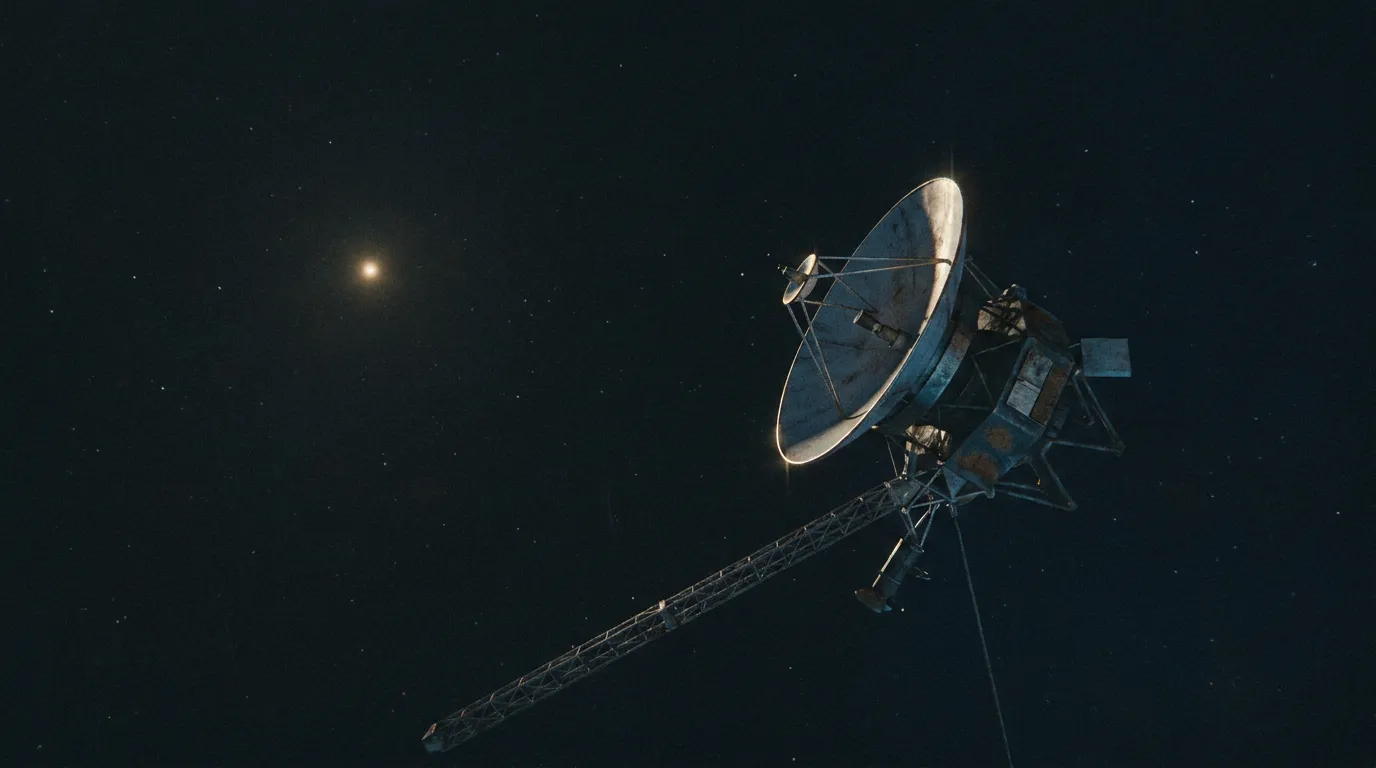
NASA said Voyager 1 reached one light-day from Earth at 2:16 a.m. PST on Nov. 18, after more than 49 years of travel. A light-day is the distance light covers in 24 hours, about 16.1 billion miles. The probe's radio signal took 24 hours to arrive, so the team at NASA's Jet Propulsion Laboratory heard from it a day later.
For scale, NASA noted that sunlight takes about four hours to reach Neptune and another 20 hours to reach Voyager 1. The team has received no science or engineering data from the spacecraft since Nov. 14, but it is still sending a carrier signal. Engineers used that signal and trajectory calculations to confirm the milestone, and they are still analyzing the data problem. Voyager 1 and Voyager 2 launched in 1977 and are the only probes in interstellar space.
Road to Mars
Planetary Society weighs Starship's success against Vulcan's failure
The Planetary Society has published a piece on what Starship's success and Vulcan's failure say about the health of the commercial launch market. It also considers what the two outcomes mean for NASA's future access to space.
Relativity fires Terran R upper stage for more than 400 seconds
Relativity Space ran a Terran R second stage through a 10-second hot fire at NASA's Stennis Space Center in October. It then completed a mission-duty-cycle firing of more than 400 seconds on the first attempt, the full upper-stage burn time. In Long Beach, the first stage's thrust structure, with all 13 Aeon R engines installed, has been rotated horizontal and is being joined to the tankage. NASASpaceflight reported the progress.
Blue Origin to launch Google's orbiting data center satellites in 2029
Blue Origin announced that its New Glenn rocket will launch satellites for Google's Project Suncatcher in 2029. Each satellite carries computing capacity roughly the scale of a data center rack. They are meant to fly in Sun-synchronous orbit, where they receive nearly continuous sunlight. Google calls the project a long-term moonshot, Ars Technica reported.
NASA fires RS-25 development engine for full 200 seconds
NASA tested RS-25 engine No. 10001 on Nov. 18 at Stennis Space Center in Mississippi, firing it for the planned three minutes and 20 seconds. The engine is a developmental unit and will not fly. The data should help improve performance and reliability for future Artemis missions. NASA said four RS-25 engines power each SLS launch, ahead of the Artemis IV landing mission planned for 2028.
Potatoes complete their life cycle in simulated lunar soil
Researchers report that potatoes grown in simulated lunar soil amended with organic matter are safe to eat. Their growth and yields were comparable to those grown on Earth. Aymeric Goyer of Oregon State University said the plants completed their entire life cycle in the material, which he called a step toward reliable food production for long-term exploration of the Moon, Phys.org reported.
The Lab
Preprint proposes tighter withdrawal controls for Bitcoin custody
A preprint on arXiv describes Release-Bound Withdrawal Authorization, a scheme meant to limit damage when a cryptocurrency withdrawal backend is compromised. The authors report that in matched synthetic tests, active probes cut permits issued through compromised signing leases from 20 to 9 out of 33, with one false fence. They say the benefit of probing depends on what evidence the operator can obtain.
Preprint finds Bitcoin anonymisation tools remain a niche
A preprint on arXiv presents a longitudinal study of second-generation privacy protocols on Bitcoin. The authors identify over 5 million candidate CoinJoin and 23.3 million candidate CoinSwap transactions. They report that these protocols typically make up less than 1% of transactions, that detectable use fell sharply after key regulatory events, and that Stealth Addresses show no standardised adoption.
Sound Money
Institutional holdings of US bitcoin ETFs reach a record
Galaxy Research reports that institutions filing Form 13F held a record 356,491 BTC in U.S. spot bitcoin exchange-traded products at the end of the third quarter. They added 49,229 BTC net during the quarter. Wells Fargo became the largest 13F holder for the first time, with 30,553 BTC, according to Bitcoin Magazine.
SEC charges eight Colorado firms over fake crypto platform scheme
The SEC charged eight Colorado-based entities with running a fake investment adviser and crypto trading platform scheme. It alleges the defendants took more than $37 million from more than 1,500 investors between at least August 2024 and May 2026. The agency said none of the crypto assets investors thought they were buying existed, Bitcoin Magazine reported.
House chairman says CLARITY Act is unlikely to pass this year
House Financial Services Chairman French Hill said the CLARITY Act is unlikely to pass before the year ends, and he plans to pursue market structure legislation in the next Congress. Sen. Bernie Moreno said the Senate will not pass crypto legislation in the lame-duck session. The Senate blocked the bill 49-50 on Sept. 15, Bitcoin Magazine reported.
Watch

Red Planet Live -- 2026 Convention Recap
Red Planet Live · Nov 18, 2026

2026 Mars Society Convention - Day 3
The Mars Society · Oct 25, 2026

RedPlanetLive - David Brin, Ph.D.
Red Planet Live · Oct 14, 2026
The Marscoin Ledger
Marscoin chain ran slightly short on blocks
Marscoin produced 690 blocks in the last 24 hours against 702 expected, reaching block height 3,605,626. Ten waits between blocks ran past 30 minutes, and the longest lasted 77 minutes. Over the last seven days there were 56 such waits. The price is $0.0602 per MARS.