The lead
Voyager 1 becomes the first object one light-day from Earth
Voyager 1 passes a distance milestone, Vulcan's failure points to fuel supply, and NASA opens a contest for mid-power electric thrusters.
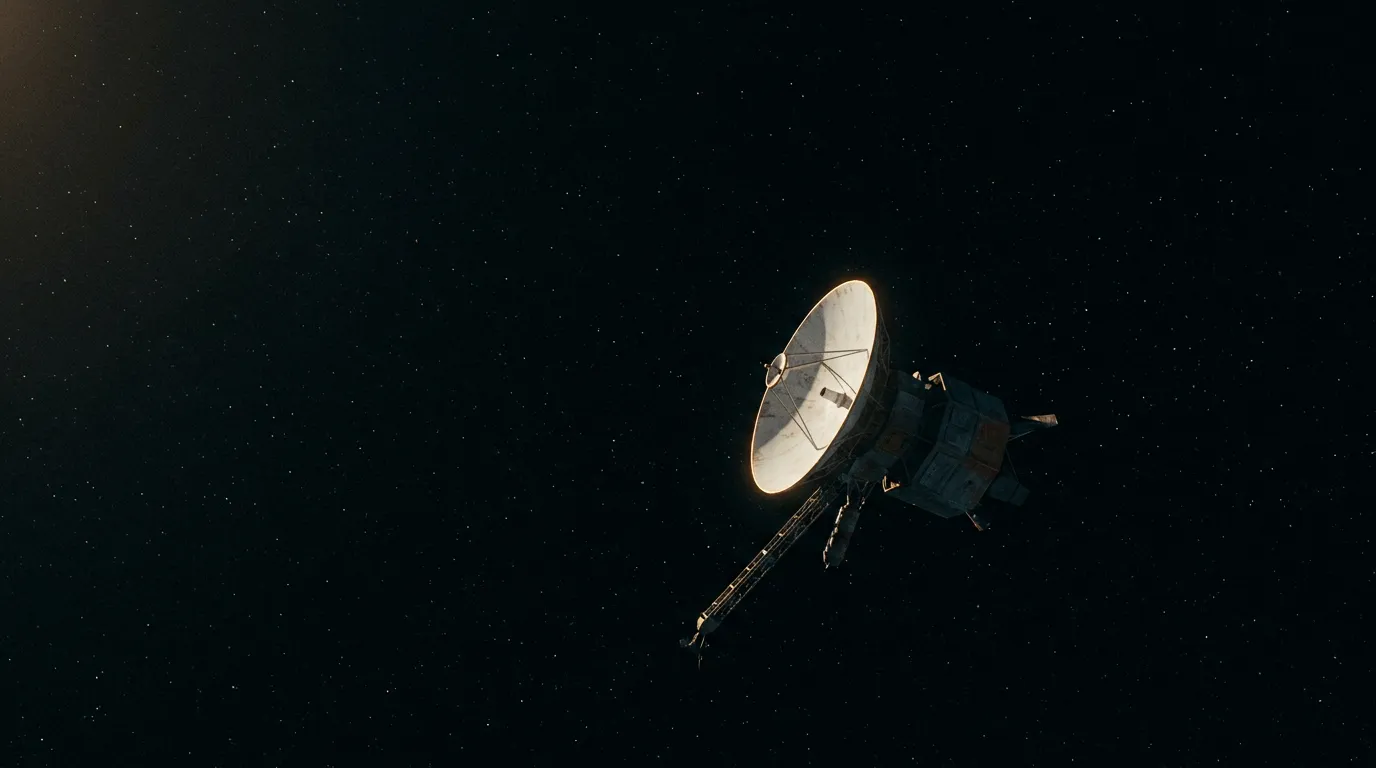
Voyager 1 crossed one light-day from Earth at 5:16:07 a.m. EST on Nov. 18, Spaceflight Now reports. The probe was about 16.1 billion miles (25.9 billion kilometers) away and moving at nearly 38,000 mph. Light covers that distance in 24 hours. A command from NASA's Deep Space Network now needs a day to arrive, and the reply needs another day to return.
NASA's Jet Propulsion Laboratory has said the crossing changes nothing on the spacecraft. Alan Cummings of Caltech, who has worked on its Cosmic Ray Subsystem since before the 1977 launch, called it "not a scientific milestone" but an engineering one. The mission is fragile. Voyager 1 has two working science instruments, its power supply shrinks each year, and it went silent for two days last month. Three full-time team members look after the Voyagers.
Sources: Spaceflight Now, NASASpaceflight, Phys.org, Ars Technica
Road to Mars
ULA points to fuel supply, not engines, in Vulcan failure
United Launch Alliance said Wednesday that preliminary data show the Vulcan booster received too little fuel from the vehicle. The company said the BE-4 engines themselves were not the problem. Sunday's launch fell short of orbit with 40 Amazon Leo satellites aboard. ULA called the finding preliminary, and Vulcan is grounded with no return date. The FAA is overseeing the investigation, Spaceflight Now reports.
Bouncing sand grains may explain Mars's planet-wide dust storms
Phys.org reports on research suggesting that bouncing sand grains may explain why dust storms on Mars grow to cover the whole planet. Such storms arise every three or four years, block sunlight and darken the surface, which matters for any future human settlement.
Potatoes complete their life cycle in simulated lunar soil
Researchers report that potatoes grown in simulated lunar soil mixed with organic matter are safe to eat. Growth and yields were comparable to those on Earth. Aymeric Goyer of Oregon State University said the potatoes completed their entire life cycle, which he called an important step toward food production for long-term exploration of the moon.
NASA opens a $500,000 contest for mid-power Hall thrusters
NASA has launched the AMPERE Challenge, inviting U.S. companies to build prototype mid-power Hall effect thrusters. Up to two winners may share $500,000, with up to $250,000 each. The contest has three phases, from concept designs to testing at NASA Glenn at no cost to the teams. NASA says the thrusters use an electric field to accelerate propellant gas. An industry day is set for Nov. 19.
First lunar-specific ground motion model aims at moonquake hazards
Phys.org reports on the first ground motion model made specifically for the moon. Civil engineers planning structures there need to know how moonquakes will shake them, and it was unclear whether models built for Earth would carry over to the lunar landscape.
The Lab
Preprint describes a fast model of Martian ice and climate
A preprint on arXiv presents version 2.3 of MAIC-2, a Fortran program that simulates Martian surface temperature, atmospheric water transport and surface glaciation. It is built for timescales of 10^5 to 10^7 years, where full circulation models cost too much. The authors say a 20-million-year run reproduces the main features of the polar layered deposits.
Preprint: new lunar retroreflector sharpens laser ranging
A preprint on arXiv analyses laser ranging data from NGLR-1, a single 10 cm retroreflector on the moon. The authors report better time-of-flight precision than the older Apollo and Lunokhod arrays. They say the results bode well for ESA's MPAc retroreflector, due to launch in early 2027, and for millimeter-scale ranging.
Sound Money
Analysis: 35.6% of unspent bitcoin sits behind exposed keys or scripts
A post on Delving Bitcoin reports that at block 975,019, 7,164,754.12 BTC of the 20,109,207.36 BTC in unspent outputs sits in outputs whose public key or script is already public. That is 35.6%. The author says P2PK, P2TR and bare multisig outputs account for 1,937,232.46 BTC of it, and the rest is in hashed address types.
Scattered Spider member sentenced to six years for crypto theft
Tyler Robert Buchanan, 24, of Dundee, Scotland, received a 72-month U.S. prison sentence on Tuesday, Bitcoin Magazine reports. Prosecutors say his phishing and SIM-swapping scheme stole at least $11.6 million in crypto. He is the fifth and final defendant sentenced in the case. A restitution hearing is set for Dec. 11.
Watch

Red Planet Live -- 2026 Convention Recap
Red Planet Live · Nov 18, 2026

2026 Mars Society Convention - Day 3
The Mars Society · Oct 25, 2026

RedPlanetLive - David Brin, Ph.D.
Red Planet Live · Oct 14, 2026
The Marscoin Ledger
Marscoin ran ahead of schedule, with ten long waits
Marscoin produced 724 blocks in the last 24 hours against 702 expected, and the median gap between blocks was 7 seconds. Ten waits ran past 30 minutes, the longest 84 minutes. Over seven days there were 52 such waits. The price is $0.0605 per MARS. The chain is at block 3,604,935.