IPAS at the 2026 International Mars Society Convention
On Thursday, October 22, 2026, Marscoin founder Lennart Lopin presents “InterPlanetary Atomic Swaps as a Settlement Primitive for the Earth–Mars Economy” at the International Mars Society Convention at the University of Southern California. According to the convention schedule, it is the first breakout session after lunch on day one: 1:00 PM in TCC 450 (Forum).
Like Lennart’s earlier Martian Republic and Hash-War talks, it is part of the Martian Republic Series. Marscoin’s first presentation to the Mars Society was in Houston in 2014. The slides are available below; you can click through them in your browser.
The argument in brief
Every financial transaction in human history has taken place within about 67 milliseconds of light, the time light needs to cross the widest distance on Earth. Mars is 3 to 22 light-minutes away, depending on where the two planets are in their orbits. For about two weeks every 26 months, when the Sun sits between them, direct radio contact stops altogether.
Wire transfers, card networks, exchanges and custodial bridges all assume that the parties can reach each other quickly and continuously. Across that distance, none of them work.
What does work is a construction Bitcoin developers have known since 2013: the hash time-locked contract (HTLC). Picture two lockboxes, one on each blockchain, both opened by the same secret. Whoever claims the first box has to reveal the secret on a public chain, and that lets the other party open the second box. Either both trades happen or neither does. Nobody holds anyone else’s money in between.
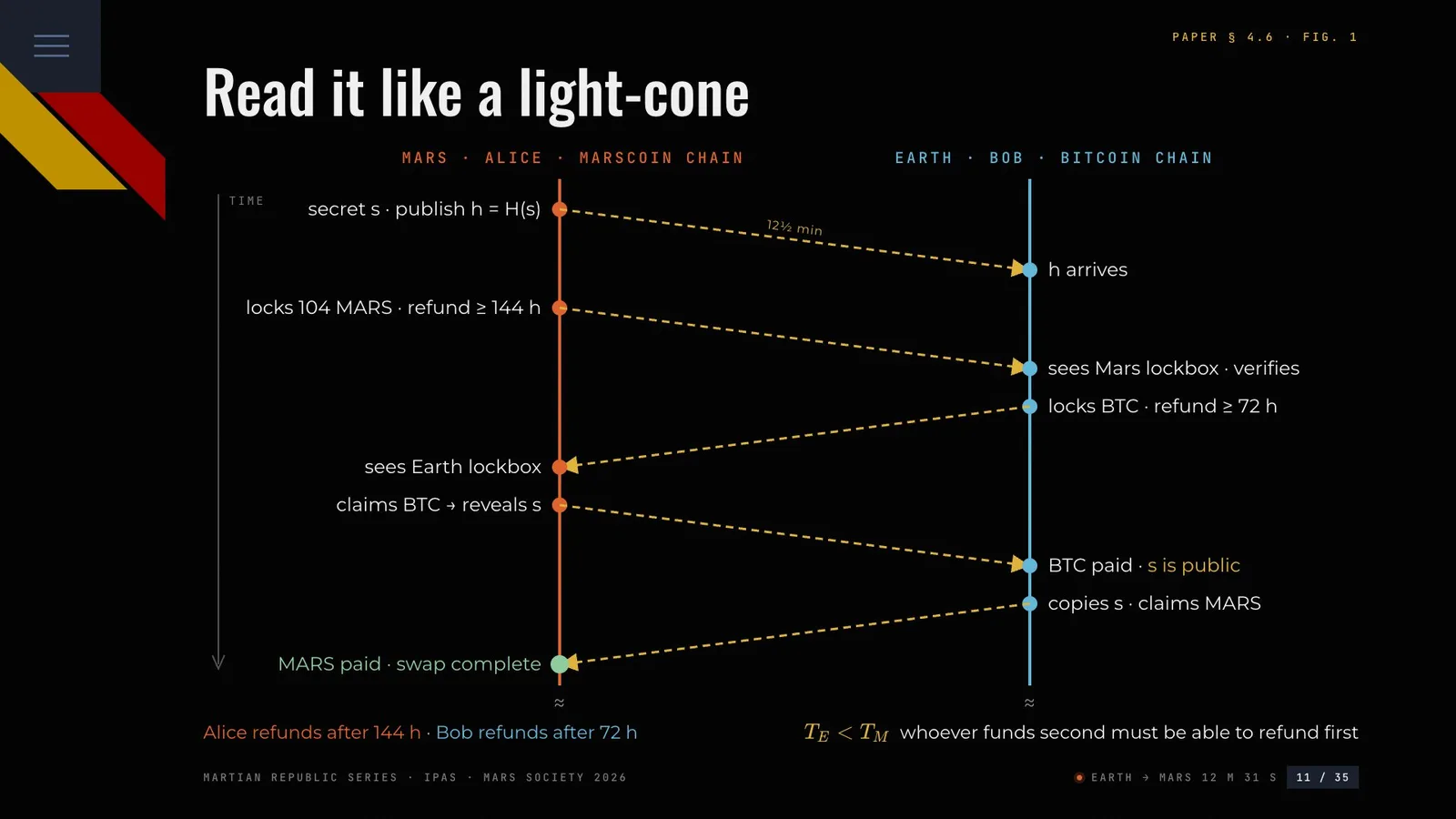
Two properties make this “accidentally interplanetary.” A hash either matches or it doesn’t, whether the secret arrives after 22 milliseconds or 22 minutes. And the refund timers count blocks on each chain, not seconds, so the two planets never have to agree on the time. That matters: a clock on Mars gains about 477 microseconds a day on one on Earth.
Sizing the window
The first mainnet swap between Bitcoin and Marscoin, completed on April 12, 2026, used refund windows of 4 and 8 hours. IPAS keeps the same protocol and widens the windows: 72 and 144 hours at average Earth–Mars distance, and 21 and 28 days for a swap that spans a solar conjunction. In the paper’s words, it is “a configuration change, not a protocol change.”
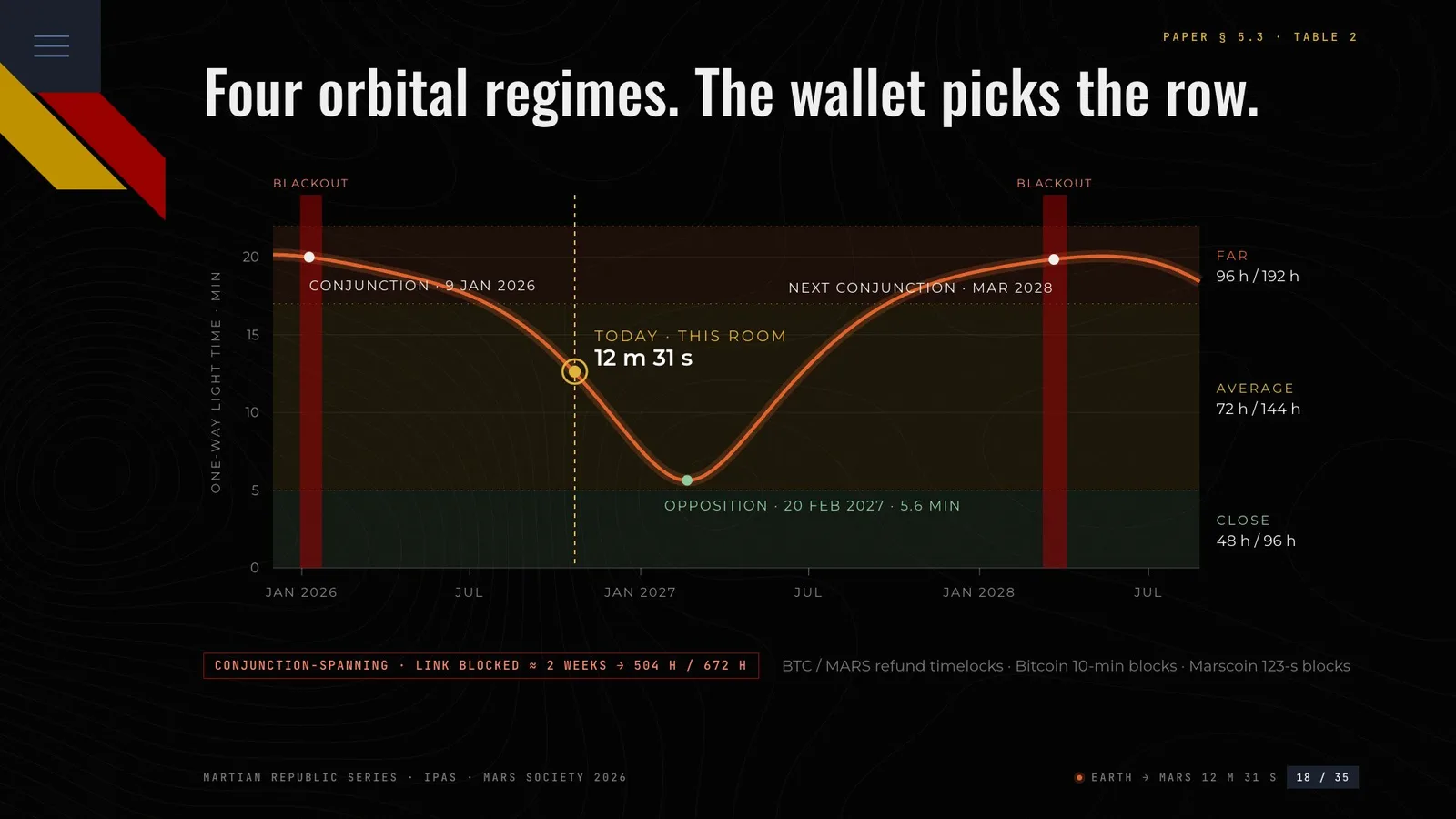
The chart in the talk plots the real Earth–Mars ephemeris for 2026 to 2028. On the afternoon of the talk, Mars is 225 million kilometres away, 12 minutes and 31 seconds by light.
A 600-year-old precedent
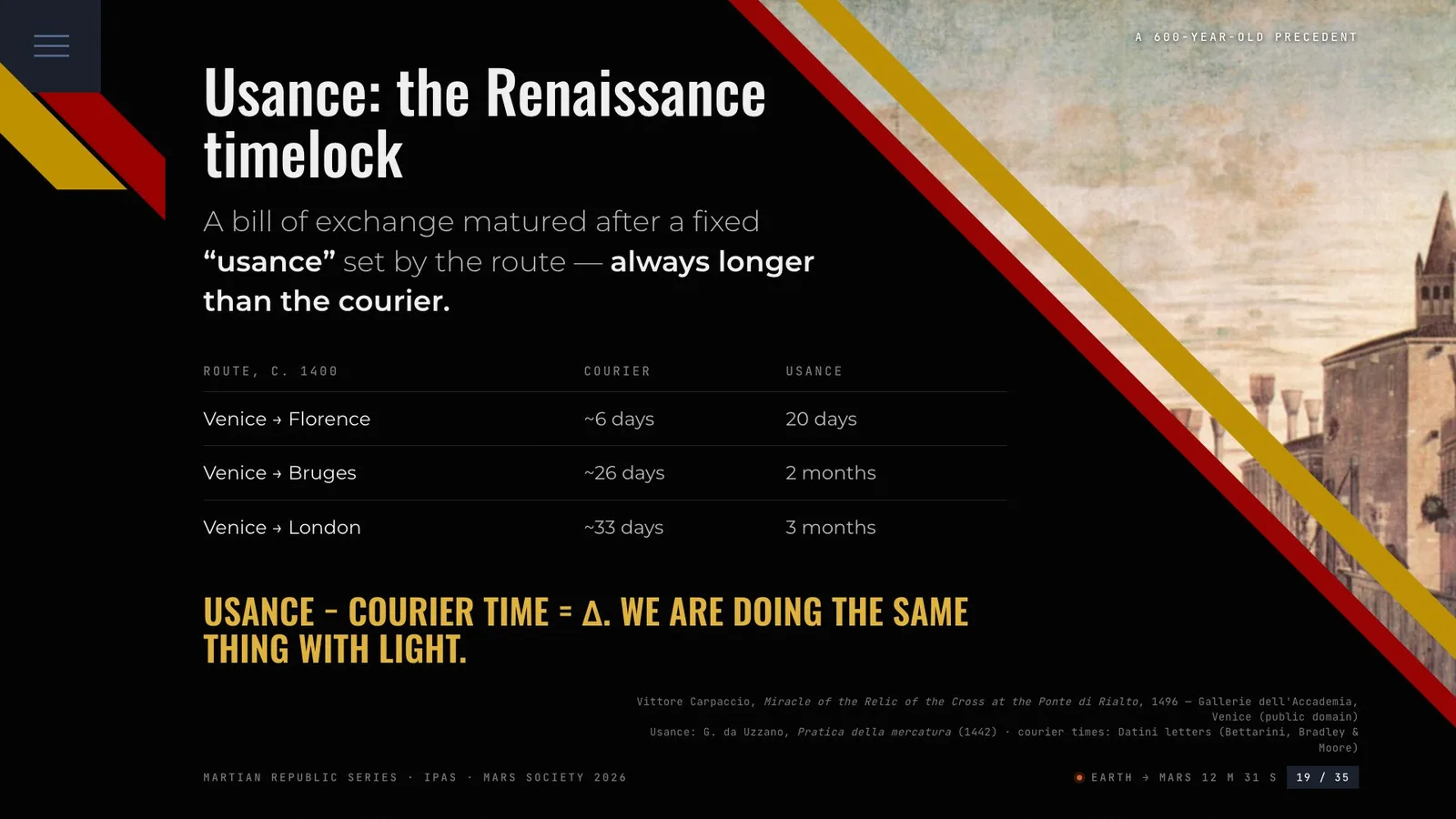
Six days can sound slow. Renaissance bankers worked the same way. A bill of exchange drawn in Venice on London matured after a fixed period called usance: three months, against a courier journey of about 33 days. The usance was always longer than the courier, so the bankers were sizing their settlement windows to the speed of the link. IPAS does the same thing with light instead of horses.
From swap to commerce
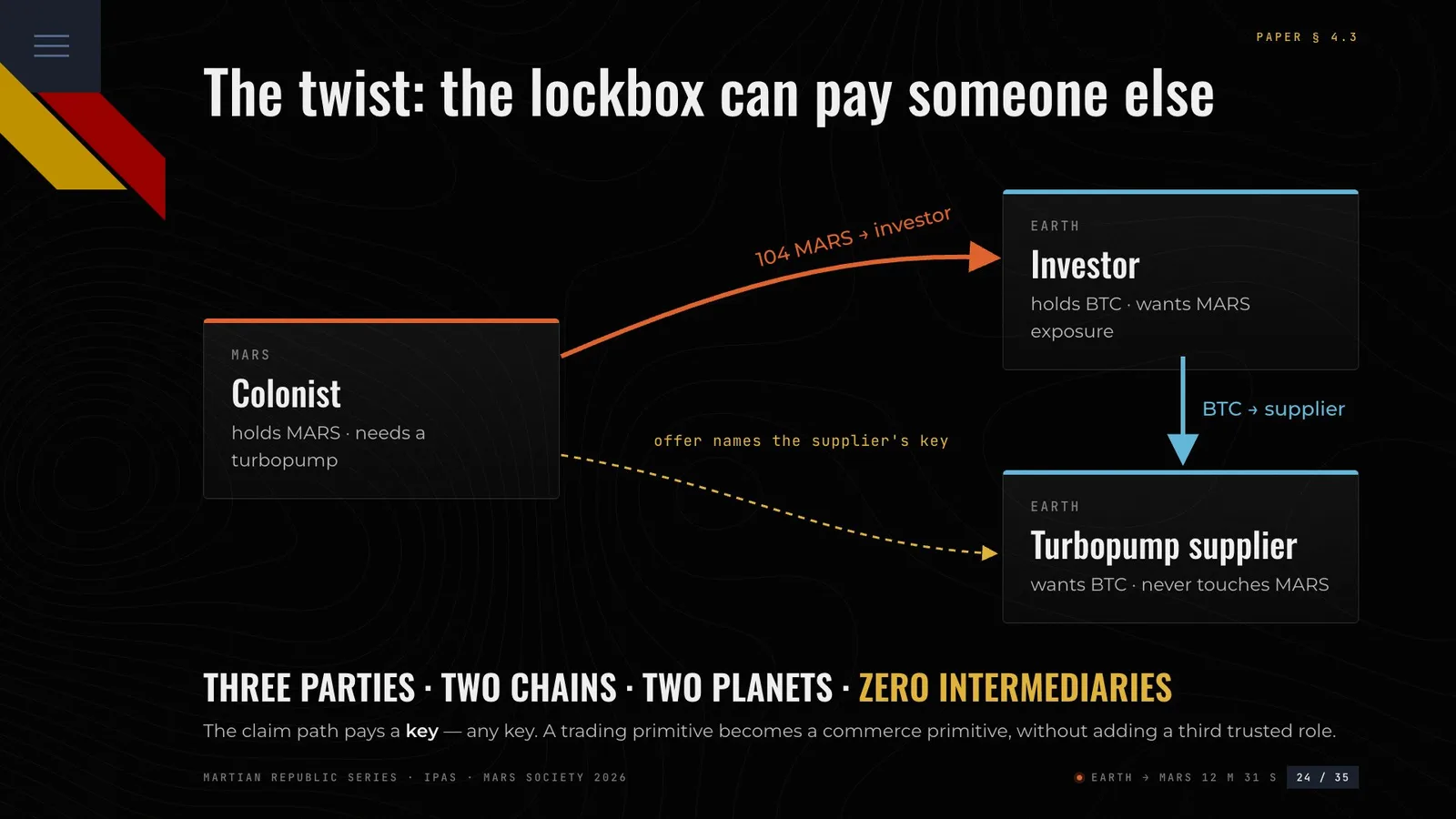
A lockbox pays a key, and that key can belong to anyone. A colonist on Mars can therefore post an offer whose bitcoin goes straight to an Earth supplier. An investor on Earth takes the offer: the investor’s bitcoin pays the supplier, and the colonist’s Marscoin goes to the investor. That gives three parties, two chains and two planets, with no intermediary and no new trusted role. The same construction covers remittances, research data sold from Mars, and capital flowing into a Martian treasury.
Slides, paper and explainer
- Slides, in your browser: marscoin.org/talks/ipas-mars-society-2026. Use the arrow keys, click or swipe; press F for full screen.
- Slides as PDF: IPAS_Lopin_MarsSociety2026_slides.pdf (6.5 MB)
- The paper: InterPlanetary Atomic Swaps (IPAS): On-Chain Hash Time-Locked Contracts as a Settlement Primitive for the Earth–Mars Economy. The LaTeX source is on GitHub under CC BY 4.0.
- The plain-language explainer: IPAS: InterPlanetary Atomic Swaps in the Academy
- Try a swap today: the Atomic Swap tab in Electrum-Mars