Light-time across the widest distance on Earth. Every financial transaction in human history has happened inside it.
02
3 ms
What Spread Networks spent $300 million to cut from the Chicago ↔ New Jersey round trip, in 2010.
03
1,320,000 ms
Earth → Mars, one way, at greatest distance.
Paper § 2.2 · real ephemeris
The link is set by orbits, not by engineers
3–22 min one way6–44 min round trip≈ 2 weeks dark every 26 months
A colonist needs a turbopump
The supplier is on Earth and wants bitcoin. The colonist holds Marscoin.
01
Wire transfer — no correspondent bank on Mars
02
Card network — no issuer, no acquirer, no chargeback desk
03
Exchange — every order loop is longer than a 6–44 min round trip
04
Custodial bridge — your money sits with a stranger 225 million km away
Every piece of the terrestrial payment stack fails.
Paper § 8.5
Trust does not survive a two-week blackout
FTX hid an $8 billion hole from customers who were milliseconds away. Now put the exchange 225 million km away — and switch the link off for 14 days.
An atomic swap has no custodian, no reserves, and no third party's solvency on the critical path.
Martian Republic Series
PART II
Two lockboxes, one secret
The atomic swap — and why it is accidentally interplanetary
Paper § 1 · historical note
2013: two conversations, one community
BitcoinTalk · May 2013
Tier Nolan: “Alt chains and atomic transfers”
Two chains. One hash. Asymmetric timeouts. Nobody in the middle.
Early Marscoin contributors · 2013
How will value ever move between planets?
One proposal: a third, deliberately slow “Interplanetary Coin” between an Earth chain and a Mars chain.
The third chain was the wrong answer to the right question. Neither side knew it was holding half of an interplanetary financial architecture.
Paper § 4.1
Two lockboxes. One secret.
Mars · Marscoin chain
104 MARS
opens for Bob — with the secret
or returns to Alice — after 144 h
h = SHA-256(secret)
9f2c 81d4 … 07b3 e81a
Earth · Bitcoin chain
0.0000365 BTC
opens for Alice — with the secret
or returns to Bob — after 72 h
1 Alice, on Mars, picks a random 32-byte secret and publishes only its fingerprint.
2 She locks 104 MARS on the Mars chain — for Bob, if he ever learns the secret.
3 Bob, on Earth, sees that lockbox and locks bitcoin on the Bitcoin chain — for Alice, same fingerprint.
4 To take the bitcoin, Alice must reveal the secret. On a public chain. Forever.
5 Bob copies it and opens the Mars box. Both trades happen — or neither does. That is “atomic”.
Paper § 4.6 · Fig. 1
Read it like a light-cone
MARS · ALICE · MARSCOIN CHAIN
EARTH · BOB · BITCOIN CHAIN
Alice refunds after 144 h · Bob refunds after 72 h whoever funds second must be able to refund first
Paper § 4.1
HTLCs are accidentally interplanetary
01
The hash doesn't know what planet it's on
SHA-256 of the secret either matches the fingerprint or it doesn't — whether it arrives after 22 milliseconds or 22 minutes.
02
The timelock counts blocks, not seconds
A refund opens when that chain reaches block height T. Each chain is its own clock. Nobody has to agree what time it is.
+477 µs
per day: how much faster a clock runs on Mars than on Earth, swinging ±226 µs over the Martian year (NIST, Dec 2025). The planets will never agree on the time. IPAS never asks them to.
Paper § 9.1 · 12 April 2026
This already works. On Earth. With real money.
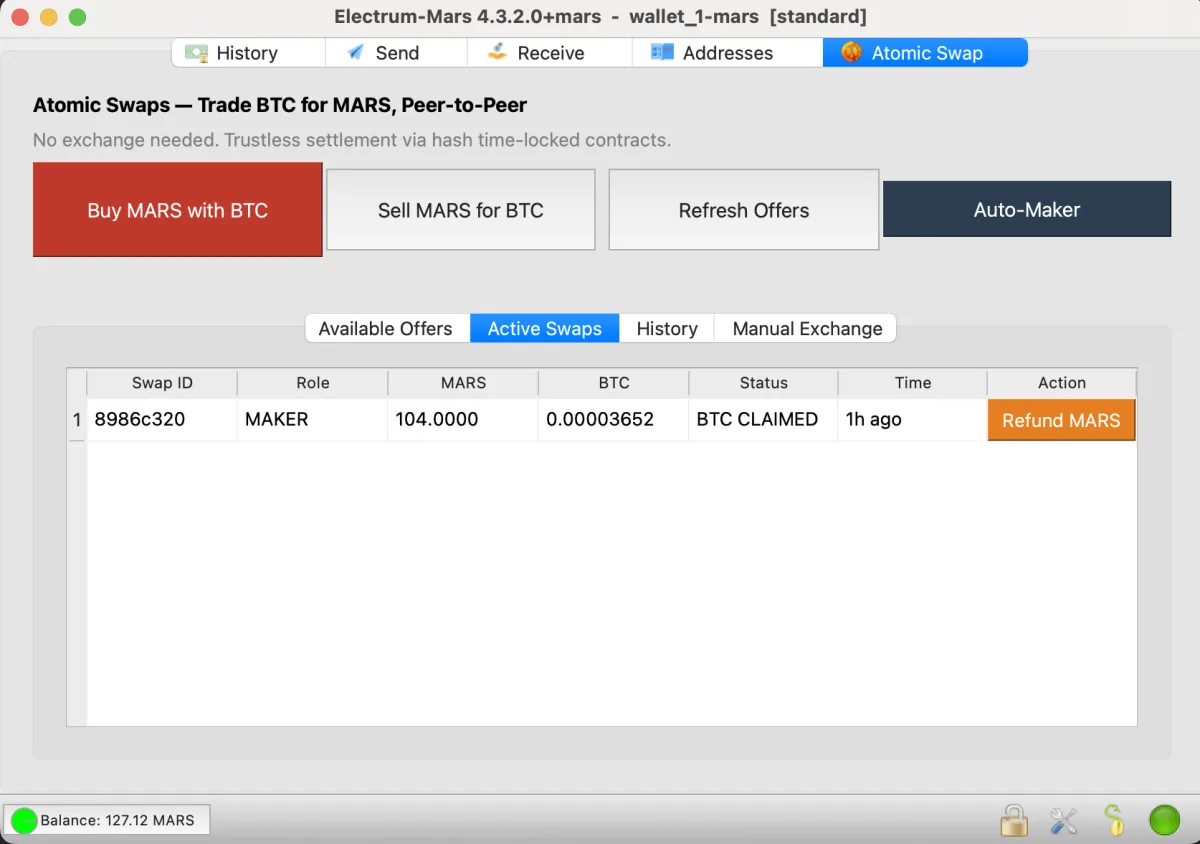
104 MARS ⇄
0.00003652 BTC
first mainnet atomic swap between Marscoin and Bitcoin
4 h / 8 h
timelocks
0
exchanges, custodians, accounts
Electrum-Mars · atomic-swap release v4.4.0-mars · open source · github.com/marscoin/electrum-mars
Paper § 9.2 – 9.3
The failures were the best part
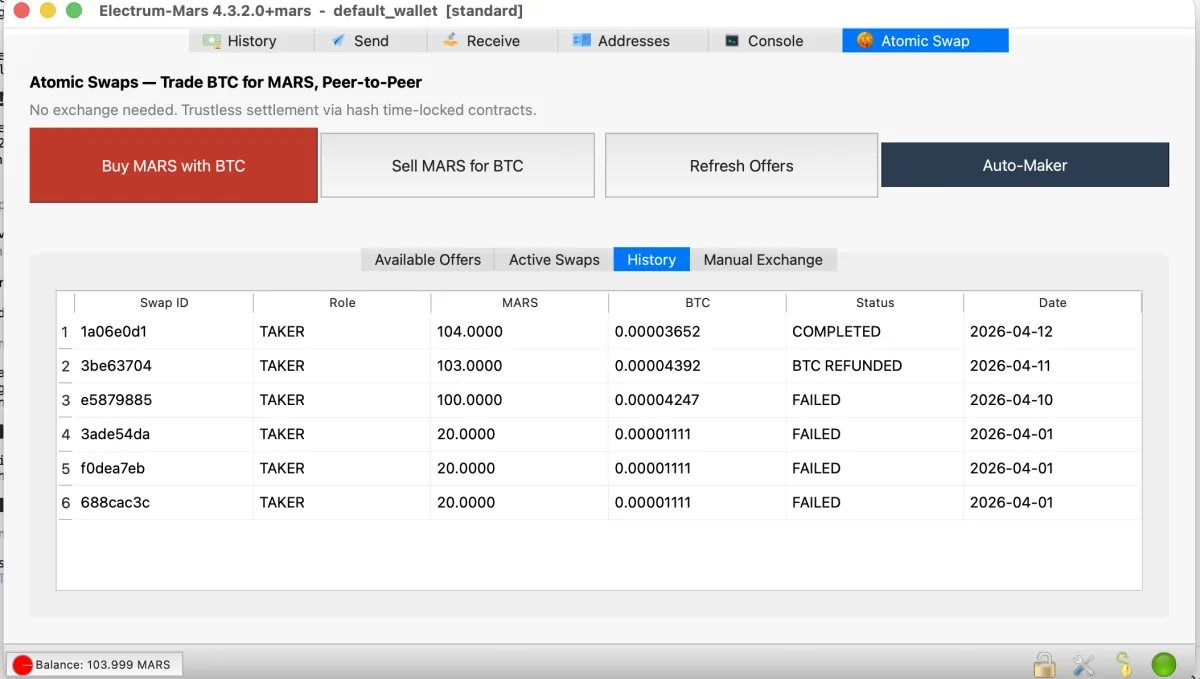
real swap history from the wallet: four failures, one refund, one success
11 April
A bug stalled the swap half-way. Four hours later the bitcoin came home by itself. The safety net is not theoretical.
12 April
Miners produced empty blocks for ~9 hours — Mars-like delay, by accident. The engine mistook delay for expiry; we fixed it live; the swap completed.
We hit the interplanetary failure mode on Earth — in public, with small money.
Martian Republic Series
PART III
Sizing the window
Timelocks, orbits — and a 600-year-old precedent
Paper § 5
Not a new protocol. A wider window.
Same code, same math — a configuration change, not a protocol change.
Paper § 5.1 – 5.2 · Eq. 3
How wide is wide enough?
The party who funds second must be able to refund first. Not a convention. A correctness condition.
Earth confirmations
light delay 3–22 min
relay scheduling
watching
building the claim
Mars confirmations
fee spikes
humility
One term is physics. Everything else is operations — engineering we control.
Evaluated at today's distance with conservative buffers: Δ = 72 h → BTC refund 72 h, MARS refund 144 h.
Paper § 5.3 · Table 2
Four orbital regimes. The wallet picks the row.
Conjunction-spanning · link blocked ≈ 2 weeks → 504 h / 672 hBTC / MARS refund timelocks · Bitcoin 10-min blocks · Marscoin 123-s blocks
A 600-year-old precedent
Usance: the Renaissance timelock
A bill of exchange matured after a fixed “usance” set by the route — always longer than the courier.
Route, c. 1400
Courier
Usance
Venice → Florence
~6 days
20 days
Venice → Bruges
~26 days
2 months
Venice → London
~33 days
3 months
Usance − courier time = Δ. We are doing the same thing with light.
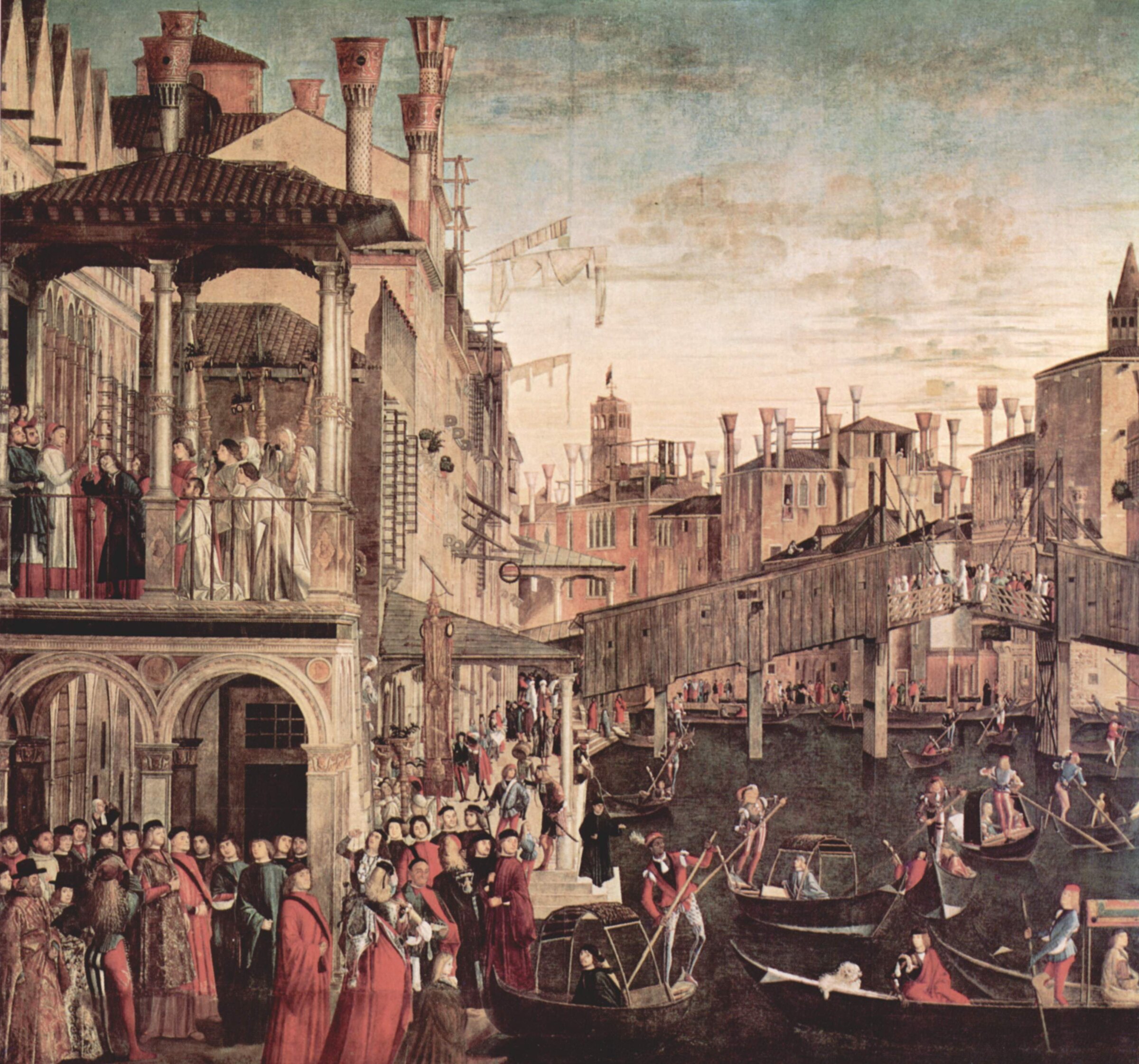
Vittore Carpaccio, Miracle of the Relic of the Cross at the Ponte di Rialto, 1496 — Gallerie dell'Accademia, Venice (public domain) Usance: G. da Uzzano, Pratica della mercatura (1442) · courier times: Datini letters (Bettarini, Bradley & Moore)
Paper § 5.3
For a civilization where cargo takes months, a six-day settlement is instant
Paper § 6.2
Mars can watch Bitcoin through a straw
≈ 1 bit/s
Every Bitcoin block header — 80 bytes, six per hour. With a Merkle proof, enough to verify a specific payment.
≈ 20 kbit/s
Every full Bitcoin block — about 9 MB an hour. That's 4% of what NASA's 20-year-old MRO sends even at maximum range.
Marscoin → Earth, full blocks: ≈ 2 MB per day · MRO downlink ≥ 500 kbit/s at max range, up to 6 Mbit/s
Paper § 6.3
Conjunction doesn't break IPAS. It changes its regime.
01
Before
Wallets switch to conjunction timelocks (21 / 28 days) — or advise waiting it out.
02
During
Each side keeps watching its own chain. A revealed secret simply waits in the block data.
03
After
Mirrors resync. Pending claims complete. No refund opened in the dark.
Next blackout ≈ 13 – 29 March 2028
Martian Republic Series
PART IV
From swap to commerce
The destination-address construction
Paper § 4.3
The twist: the lockbox can pay someone else
Mars
Colonist
holds MARS · needs a turbopump
Earth
Investor
holds BTC · wants MARS exposure
Earth
Turbopump supplier
wants BTC · never touches MARS
Three parties · two chains · two planets · zero intermediaries
The claim path pays a key — any key. A trading primitive becomes a commerce primitive, without adding a third trusted role.
Paper § 4.3 · six worked examples
What a commerce primitive unlocks
Pay an Earth supplier
From a Mars wallet, straight to the turbopump maker. No bank on either planet.
Sell a Martian dataset
The secret that settles payment also releases the hash-addressed data. Settlement = delivery.
Emergency medicine
The antibiotic is paid for in days. The cargo follows on the next transfer window.
Fund a Martian treasury
Earth capital into an on-chain multisig in days, not grant cycles — auditable by anyone.
License Martian invention
A patent licence to an Earth firm, its settlement timestamped on both chains.
Remittance
A grandparent on Earth sends MARS straight to a grandchild born on Mars.
Paper § 8.2
The first child born on Mars will get birthday money from Earth.
Hawala has moved money this way — on trust — for 1,200 years. IPAS does it with a 32-byte secret.
Paper § 8.4
Every new kind of value needed a new kind of market
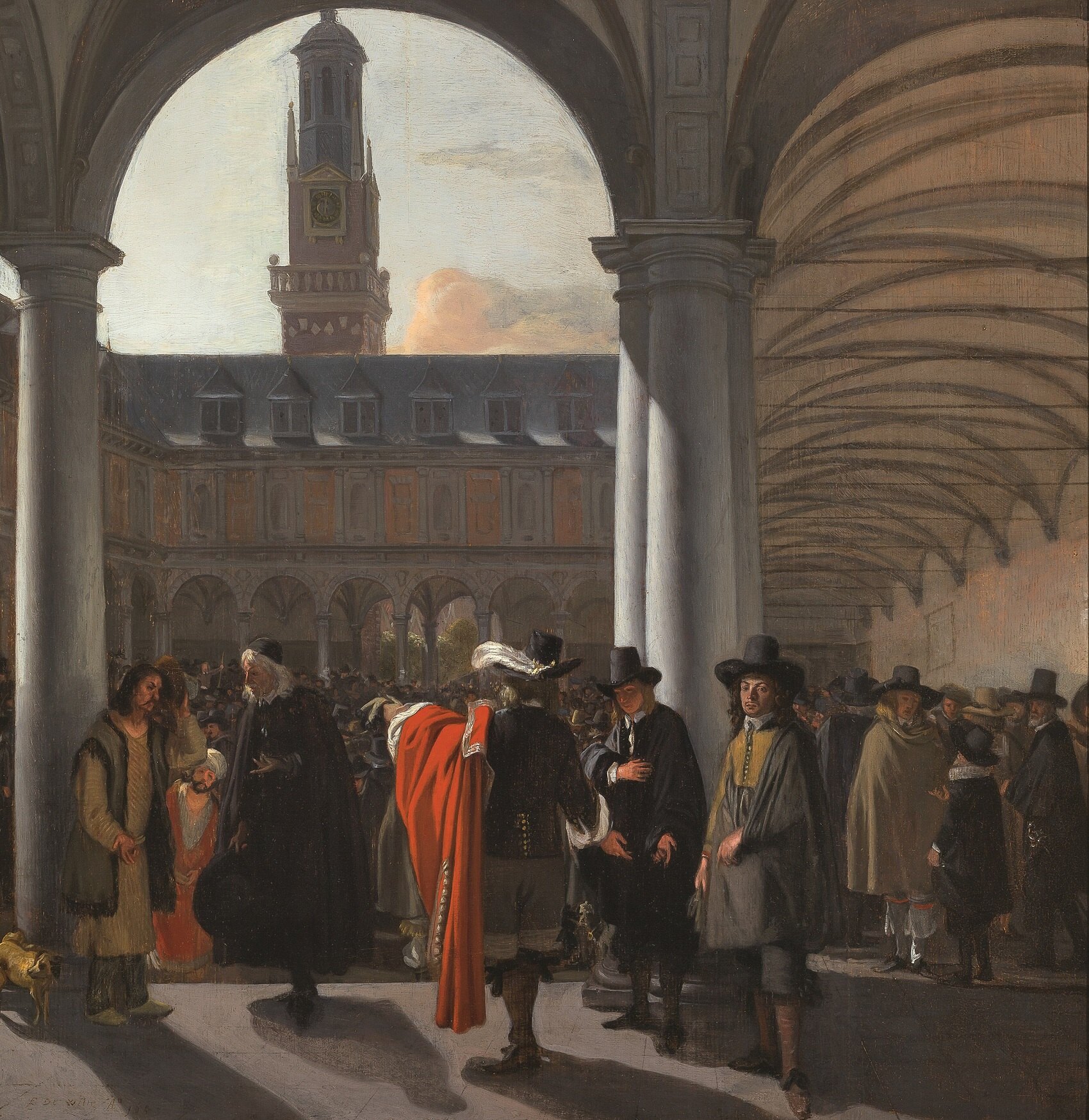
1602
Amsterdam — VOC shares: the first liquid stock market
1865
Chicago — standardized grain futures
20—
Earth ↔ Mars — the first interplanetary exchange rate, set peer-to-peer and settled by hash
Emanuel de Witte, The Courtyard of the Exchange in Amsterdam, 17th c. (public domain)
Paper § 7
Why not Lightning?
Bitcoin's off-chain payment channels: brilliant on Earth, fragile across 22 minutes and 14 dark days.