The Citizen Registry: Decentralized Identity on Mars
How the Martian Republic citizen registry works — application process, peer attestation for proof of humanity, status levels from newcomer to citizen, voting rights progression, and profile management.
Why Identity Matters on Mars
Every governance system begins with the same question: who gets to participate? On Earth, identity is established through layers of institutional infrastructure — birth certificates, passports, national ID databases, biometric records. These systems are the product of centuries of bureaucratic evolution and billions of dollars of institutional investment. None of them will exist on Mars.
Yet identity is not optional. Without a reliable way to distinguish unique human participants, a governance system cannot function. Voting requires one-person-one-vote. Resource allocation requires knowing who exists. Scientific attribution requires verified authorship. Contract enforcement requires identifiable parties.
The Martian Republic’s Citizen Registry solves this problem through decentralized, peer-attested identity — a system where the community verifies its own members without relying on any central authority.
How Registration Works
Step 1: Create Your Wallet
Citizenship begins with cryptography. When a prospective citizen downloads the Martian Republic application (available on iOS and Android), the app generates a hierarchical deterministic (HD) wallet from a randomly generated 12-word seed phrase. This seed phrase is the citizen’s master key — from it, all subsequent keys for financial transactions, voting, logbook entries, and identity verification are mathematically derived.
The seed phrase is displayed exactly once and must be written down and stored securely. No server ever sees it. No administrator can recover it. The citizen has sovereign control over their own identity from the first moment.
Step 2: Submit an Application
With wallet in hand, the prospective citizen submits a citizenship application through the app. The application includes:
- A public key derived from the HD wallet, which becomes the citizen’s on-chain identifier
- A display name — how the citizen will appear in governance interfaces
- Optional profile information — location, area of specialization, biographical details
The application is recorded on the Marscoin blockchain as a transaction, creating an immutable timestamp of when the application was submitted. From this moment, the applicant’s status is tracked on-chain.
Step 3: Peer Attestation
This is the core mechanism that replaces institutional identity verification. Instead of presenting documents to a government bureau, the applicant must be vouched for by existing citizens.
Each attestation is a signed blockchain transaction. When a citizen attests for an applicant, they are making a public, permanent, cryptographically signed statement: “I verify that this person is a real, unique human being.” The attestation is recorded on the Marscoin blockchain, creating an auditable trail of who vouched for whom.
The attestation process serves as the Martian Republic’s proof of humanity — a way to ensure that each registered identity corresponds to a real, unique person. On Mars, where the community is small and everyone knows each other physically, this is a natural and robust verification method. Fake identities are extraordinarily difficult to maintain when your neighbors share a habitat with you.
Step 4: Threshold and Confirmation
Once the applicant has received attestations from a minimum number of existing citizens (a governance parameter that can be adjusted by vote), their status is elevated. The citizen’s public key is added to the on-chain registry of verified citizens, and they gain access to the full suite of governance tools.
Status Levels and Progression
The Citizen Registry implements a progressive status system that reflects a citizen’s journey from first contact to full participation. Each level unlocks additional capabilities within the Martian Republic.
Newcomer
The entry point. A newcomer has downloaded the Martian Republic app and created an HD wallet, but has not yet submitted a formal citizenship application. At this level, the user can:
- Send and receive MARS using their wallet
- Browse governance proposals and community discussions
- View the research logbook and resource inventory
- Explore the planetary registry
Newcomers can observe the republic in action, but they cannot yet participate in it.
Applicant
Once a newcomer submits a citizenship application, their status becomes applicant. The application is recorded on-chain, and the peer attestation process begins. Applicants can:
- Everything a newcomer can do
- Appear in the citizen directory as a pending applicant
- Request attestations from existing citizens
- Begin building their profile
The applicant phase is a social process. It requires engaging with the existing community, introducing yourself, and building trust. In a Mars settlement, this would happen naturally through shared work and daily interaction. On Earth today, it happens through the Martian Republic’s community channels.
General Public
After receiving initial attestations — enough to establish basic identity but not yet full citizenship — the applicant’s status becomes general_public. This intermediate level grants:
- Everything an applicant can do
- The ability to post to the community feed
- Access to submit research logbook entries
- Participation in non-binding polls and discussions
General public status represents a verified identity that has not yet achieved the full trust threshold required for governance participation.
Citizen
Full citizenship is achieved when the attestation threshold is met. Citizens have complete access to the Martian Republic:
- Voting rights — participate in congressional votes on governance proposals
- Proposal submission — submit new proposals for community consideration
- Attestation authority — vouch for new applicants, extending the web of trust
- Full logbook access — submit research entries that are blockchain-anchored
- Resource inventory — contribute to resource tracking
- Planetary registry — add geographic data and survey results
Citizenship is the keystone of the system. It represents the community’s collective judgment that you are a real person, a genuine participant, and a trusted member of the republic.
Voting Rights Progression
The status system creates a natural progression of voting rights that balances inclusivity with security:
| Status | Can Vote | Can Propose | Can Attest |
|---|---|---|---|
| Newcomer | No | No | No |
| Applicant | No | No | No |
| General Public | Non-binding polls only | No | No |
| Citizen | Full voting rights | Yes | Yes |
This progression ensures that governance power is only granted to verified, trusted members of the community. It prevents Sybil attacks (creating fake identities to stuff ballot boxes) while still allowing newcomers to observe and learn before they participate.
The progression also mirrors what would happen naturally in a Mars settlement. New arrivals would observe, learn, build relationships, and gradually earn the trust of the existing community before being entrusted with governance responsibilities.
Profile Management
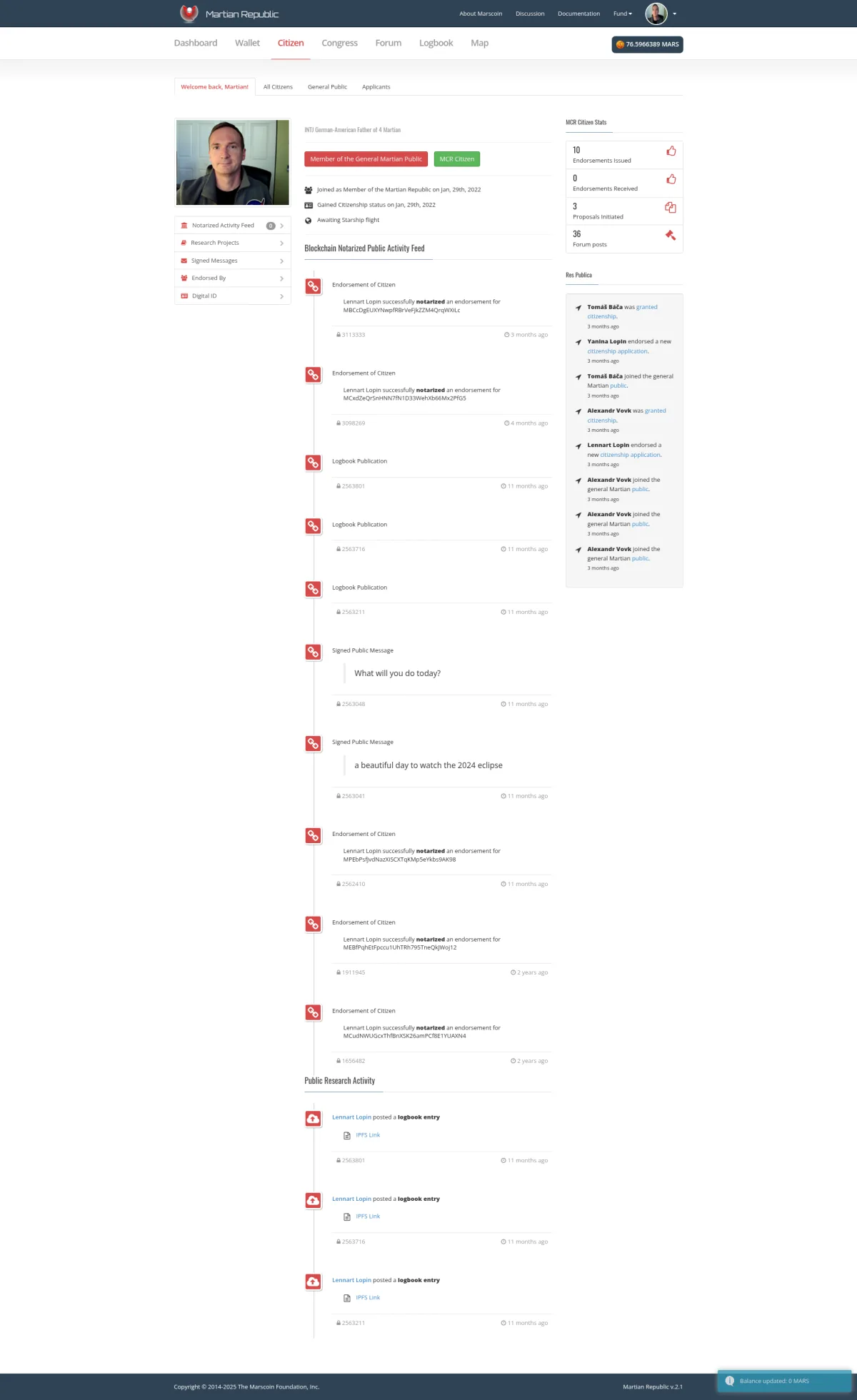
Each citizen maintains a profile within the Martian Republic, stored partly on-chain (immutable, verified data) and partly on IPFS (larger content, linked by hash). The profile includes:
On-Chain Data
- Public key — the citizen’s cryptographic identity
- Status level — current position in the progression
- Registration date — when the application was submitted
- Attestation count — how many citizens have vouched for this identity
- Voting record — participation history (which votes they participated in, not how they voted — ballot secrecy is preserved via CoinShuffle)
Profile Fields
- Display name — how the citizen appears in the Martian Republic interface
- Location — current location, whether on Earth (city, country) or on Mars (settlement, habitat)
- Specialization — area of expertise or focus (engineering, biology, geology, governance, medicine, etc.)
- Biography — a brief description of background and interests
- Avatar — a profile image stored on IPFS
Profile fields can be updated at any time through the Martian Republic app. Changes to core identity fields (public key, status) require attestation or governance action; changes to descriptive fields (display name, biography, location) are at the citizen’s discretion.
Why Specialization Matters
The specialization field is more than a social feature. On Mars, where every person’s skills are critical to survival, knowing who can do what is operational intelligence. If a water recycling system fails, the settlement needs to know immediately who has the engineering expertise to fix it. The citizen registry doubles as a skills directory for the settlement.
Security Considerations
Sybil Resistance
The peer attestation model is inherently Sybil-resistant in a small, physically co-located community. Creating a fake citizen requires convincing multiple real citizens to vouch for a nonexistent person — a social engineering challenge that becomes progressively harder as the attestation threshold increases and the community becomes more vigilant.
Key Loss and Recovery
If a citizen loses their seed phrase and their device fails, their identity is cryptographically irrecoverable. This is a deliberate design choice — it means no central authority can seize or impersonate a citizen’s identity. However, it places the responsibility squarely on the individual to protect their seed phrase.
In the event of key loss, the citizen must re-register with a new key pair and go through the attestation process again. The community knows them, so re-attestation should be straightforward, but the on-chain history associated with their old key cannot be transferred to the new one.
Privacy and Transparency
The registry balances privacy with transparency. Attestations are public (so the community can verify the integrity of the identity system), but personal profile information is optional. A citizen can participate fully in governance with nothing more than a public key and a display name.
Building the Web of Trust
Every attestation strengthens the citizen registry. As the number of verified citizens grows and the web of attestations becomes denser, the system becomes increasingly difficult to compromise. Each new attestation is a thread in a growing fabric of mutual verification.
On Mars, this web of trust will be grounded in physical reality — you attest for people you live with, work with, and depend on for survival. On Earth today, it is an experiment in building that same trust through shared purpose and community participation.
The Citizen Registry is not just a membership list. It is the foundation on which every other function of the Martian Republic is built — voting, resource allocation, scientific records, geographic mapping. Without reliable identity, none of these systems can function. With it, a community of strangers can govern themselves without institutions, without bureaucracy, and without a central authority.
To understand how citizens use their voting rights, see Congressional Voting: Direct Democracy on the Blockchain. For the full governance architecture, see The Martian Republic: Blockchain Governance for Mars. To get started with the Martian Republic app, see Getting Started with Marscoin.