The Martian Republic: Blockchain Governance for Mars
A comprehensive guide to the Martian Republic governance platform — citizen registry, congressional voting with CoinShuffle ballots, IPFS-anchored records, research logbooks, inventory tracking, and the philosophy of encoding a republic in code.
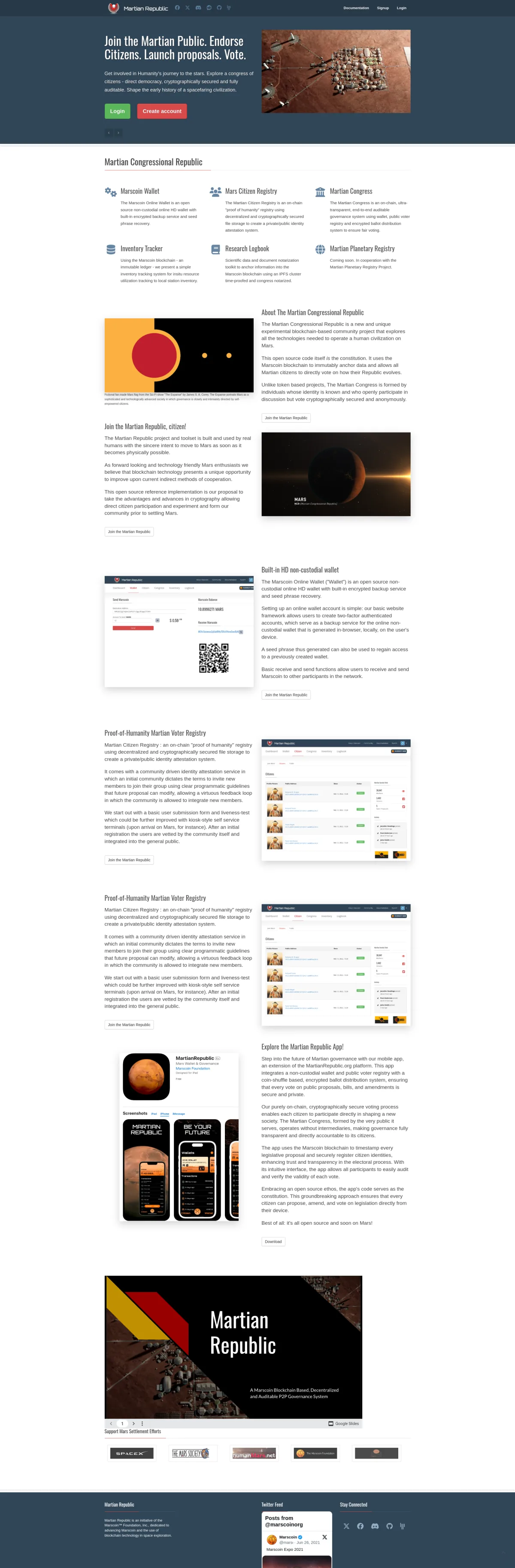
The Republic-as-Software Philosophy
Throughout human history, republics have been defined by documents — constitutions, charters, declarations. These documents describe how power is distributed, how decisions are made, and how the rights of individuals are protected. But documents are interpreted by humans, enforced by institutions, and amended by political processes. They are agreements about behavior, not guarantees of it.
The Martian Republic represents a fundamentally different approach: the republic is software. The rules of governance are not merely described in a document — they are encoded in a protocol. Voting is not an honor system overseen by election officials; it is a cryptographic process that produces a mathematically verifiable result. Identity is not attested by a government bureau; it is established through peer verification and anchored to the blockchain. Records are not stored in filing cabinets subject to loss, alteration, or censorship; they are immutably timestamped on a distributed ledger.
This is not governance-by-technology for its own sake. It is a pragmatic response to the specific conditions of a Mars settlement:
- No existing institutions. There are no courts, no police, no bureaucracy. Governance must be self-enforcing.
- Small population. With dozens to hundreds of people, every individual’s participation is critical. The system must be efficient and inclusive.
- Limited communication. The 4-to-24-minute delay to Earth means Mars cannot depend on Earth-based arbitration or oversight.
- High stakes. In a life-support-dependent environment, governance failures can be lethal. The system must be reliable.
The Martian Republic is the governance layer built on top of the Marscoin blockchain, designed to meet all of these requirements.
The Non-Custodial HD Wallet
Every citizen of the Martian Republic begins with a hierarchical deterministic (HD) wallet — a cryptographic key structure that generates all of their blockchain identities from a single seed phrase.
Why HD Wallets
An HD wallet derives an essentially unlimited number of private keys and corresponding public addresses from a single 12- or 24-word seed phrase. This design has critical advantages for a governance system:
- Single backup. A citizen needs to protect only their seed phrase. From it, all keys — financial, voting, identity — can be regenerated.
- Compartmentalization. Different keys can be used for different purposes (one for financial transactions, one for voting, one for research logbook entries), preventing correlation unless the citizen chooses to link them.
- Non-custodial. No central authority holds the citizen’s keys. The citizen has sovereign control over their identity and assets. There is no administrator who can freeze accounts, no server that can be seized.
Implementation
The Martian Republic mobile application (available on iOS and Android) generates an HD wallet on first launch. The seed phrase is displayed once and must be written down by the user. The application stores the encrypted keys locally on the device. No server ever sees the seed phrase or private keys.
From this wallet, the application derives:
- A primary financial address for sending and receiving MARS
- A citizenship key used for identity verification and governance participation
- Purpose-specific keys for voting, logbook entries, and other functions
Citizen Registry with Proof of Humanity
The Problem of Identity on Mars
On Earth, identity is established through a web of institutions: birth certificates, government IDs, social security numbers, biometric databases. None of these will exist on Mars initially. Yet the governance system requires a reliable way to distinguish between unique human citizens and ensure that each person gets exactly one vote.
Peer Attestation
The Martian Republic uses a peer attestation model for citizenship verification. The process works as follows:
- Application. A prospective citizen creates an HD wallet and submits a citizenship application through the Martian Republic app. The application includes a public key and optional identifying information.
- Attestation. Existing citizens vouch for the applicant’s identity and humanity. Each attestation is a signed transaction on the Marscoin blockchain, creating a permanent, verifiable record.
- Threshold. Once the applicant has received attestations from a minimum number of existing citizens (the specific threshold is a governance parameter), their citizenship is confirmed.
- Registration. The citizen’s public key is added to the on-chain citizen registry, and they gain the ability to participate in governance votes, submit logbook entries, and access other republic functions.
Why Peer Attestation Works for Mars
This model is well-suited to Mars for several reasons:
- Small community. In a settlement of dozens to hundreds of people, everyone knows everyone. Fake identities are extremely difficult to maintain when your neighbors can physically verify your existence.
- No central authority. There is no immigration office or identity bureau. The community verifies its own members.
- Sybil resistance. An attacker trying to create fake citizens would need to convince multiple existing citizens to vouch for nonexistent people — a social engineering challenge that scales poorly in a tight-knit physical community.
- Graceful bootstrapping. The first citizens are attested by the system’s founders. As the community grows, the web of attestations becomes increasingly robust.
Congressional Voting with CoinShuffle
The Voting Problem
Democratic governance requires two seemingly contradictory properties:
- Verifiability. Every participant must be able to confirm that the final tally accurately reflects the votes cast.
- Secrecy. No one should be able to determine how any individual voted.
In a small community, these properties are even harder to achieve simultaneously. With only a few dozen voters, statistical inference can sometimes reveal individual votes even from aggregated tallies. And social pressure in a small settlement — where you must live and work alongside everyone — makes ballot secrecy critically important.
CoinShuffle Encrypted Ballots
The Martian Republic’s voting system uses CoinShuffle, a decentralized mixing protocol, to achieve both verifiability and secrecy without a trusted third party.
The protocol operates in rounds:
- Proposal. A governance proposal is submitted to the blockchain, specifying the question, the options, and the voting period.
- Eligibility. The smart contract (or consensus rule) verifies that only registered citizens with active attestations can participate.
- Encryption. Each voter encrypts their ballot using a layered encryption scheme (similar to onion routing). The outermost layer is encrypted with the last participant’s key, the next layer with the second-to-last participant’s key, and so on.
- Shuffle. Participants sequentially decrypt one layer and shuffle the order of the ballots. After all participants have processed the batch, the ballots are fully decrypted but their order is randomized — it is impossible to trace any ballot back to its originator.
- Tally. The decrypted, shuffled ballots are counted publicly. Anyone can verify the count, but no one can determine who cast which vote.
Properties
- One citizen, one vote. The citizen registry ensures that only verified humans vote, and the protocol prevents double-voting.
- No trusted authority. There is no election commission, no ballot box, no counting official. The protocol is the authority.
- Collusion resistance. Even if a subset of participants collude, they cannot deanonymize ballots without controlling all participants in the shuffle.
- Auditability. The entire process is recorded on the blockchain. Any citizen can independently verify that the protocol was followed correctly.
IPFS Integration for Record Anchoring
The Problem of Storage
Blockchain storage is expensive and permanent. Storing large documents — scientific papers, habitat blueprints, photographic surveys — directly on the blockchain is impractical. Yet these records need to be immutably timestamped and publicly verifiable.
The IPFS Solution
The Martian Republic uses the InterPlanetary File System (IPFS) as a content-addressed storage layer. Documents are stored on IPFS, which generates a unique content hash (CID) based on the file’s contents. This hash is then recorded on the Marscoin blockchain.
The resulting system has two critical properties:
- Integrity. If anyone modifies the document, its IPFS hash changes, breaking the link to the blockchain record. The on-chain hash serves as a permanent, tamper-evident fingerprint.
- Availability. The document itself is stored on IPFS, which can be replicated across multiple nodes. On Mars, a local IPFS network would provide fast access to all pinned documents.
This architecture is used for research logbook entries, governance proposals, meeting minutes, survey data, and any other document that requires permanent, verifiable preservation.
Research Logbook
Scientific Integrity on Mars
Mars settlement will be, in its earliest phases, primarily a scientific endeavor. The integrity of scientific data — observations, experiments, measurements — is paramount. On Earth, scientific integrity relies on institutional review boards, journal peer review, and reputational incentives. On Mars, these institutions will not initially exist.
Blockchain-Anchored Observations
The Martian Republic’s research logbook provides an alternative: blockchain-timestamped, IPFS-stored scientific records.
A researcher records an observation or experimental result through the Martian Republic application. The entry is:
- Signed with the researcher’s citizenship key (proving authorship)
- Stored on IPFS (providing content-addressed storage)
- Anchored to the Marscoin blockchain (providing an immutable timestamp)
The result is a scientific record that is:
- Attributable. The cryptographic signature proves who made the entry.
- Timestamped. The blockchain provides a tamper-proof record of when the entry was made.
- Immutable. Neither the entry nor its timestamp can be altered after the fact.
- Independently verifiable. Any citizen can verify the authorship, timestamp, and integrity of any logbook entry.
This system does not replace peer review — it provides the evidentiary foundation on which peer review can later be built. When a Mars-based scientific community eventually establishes its own journals and review processes, the logbook provides a trustworthy corpus of primary data.
Inventory Tracking
Resource Management as Governance
In a Mars settlement, resource management is not merely an accounting function — it is a governance function. Water, oxygen, power, food, raw materials, and manufactured goods are finite and critical. Transparent allocation and tracking of these resources is essential for community trust and survival.
The On-Chain Inventory
The Martian Republic includes an inventory tracking module that records resource allocation and consumption on the Marscoin blockchain. Each resource entry includes:
- Type and quantity of the resource
- Allocation (who received it and for what purpose)
- Consumption (when it was used or consumed)
- Provenance (where it came from — mined locally, manufactured, or shipped from Earth)
Because these records are on the blockchain, they are transparent, immutable, and auditable. Any citizen can verify that resources are being allocated according to community-approved policies. Disputes over resource allocation can be resolved by reference to an objective, tamper-proof record.
Planetary Registry
Mapping Mars as a Commons
As the Mars settlement expands, the community will need to map and catalog the terrain: landing sites, resource deposits, trail routes, hazard zones, and points of scientific interest. This geographic data is a shared resource — a commons that belongs to the entire community.
Cooperative Cartography
The Martian Republic’s planetary registry is a cooperative mapping system where citizens contribute geographic data that is anchored to the blockchain. Each registry entry includes:
- Coordinates (areographic latitude and longitude)
- Description of the feature
- Supporting data (photographs, measurements, survey results) stored on IPFS
- Contributor attribution via cryptographic signature
- Timestamp via blockchain anchoring
Over time, the registry builds into a comprehensive, community-verified atlas of the settlement area and surrounding terrain. Because contributions are signed and timestamped, priority disputes (who discovered a feature first) can be resolved objectively.
Current Status
The Martian Republic is not a future concept — it is operational software. The mobile application is available on both iOS and Android, and provides:
- HD wallet creation and management
- Citizen registration and peer attestation
- Governance proposal submission and CoinShuffle voting
- Research logbook entries with IPFS anchoring
- Inventory tracking
- Planetary registry contributions
Today, the Martian Republic operates as a testbed — a functioning prototype that the Mars-enthusiast community uses on Earth to test, refine, and improve the governance infrastructure. Every vote cast, every logbook entry made, and every registry contribution filed is a rehearsal for the day when these tools are used for real, on Mars.
The same rehearsal logic extends beyond governance. The Martian Navy Academy trains the human side of the equation: a free academy, set in the Marscoin universe, that teaches the actual mathematics and engineering a settlement will run on — pressure calculations, rendezvous solutions, system verification — through fleet service, rank by rank. Citizens vote; crews calculate. Both are practicing.
The Martian Republic application is available on iOS and Android. For the philosophical and technical foundations, see the Marscoin Whitepaper. To get started, see Getting Started with Marscoin.