The lead
NASA announces a long list of lunar awards and solicitations at once
NASA's Moon Base contract blitz, Curiosity's drill campaign at Nazca, and Hera's close look at the asteroid NASA struck.
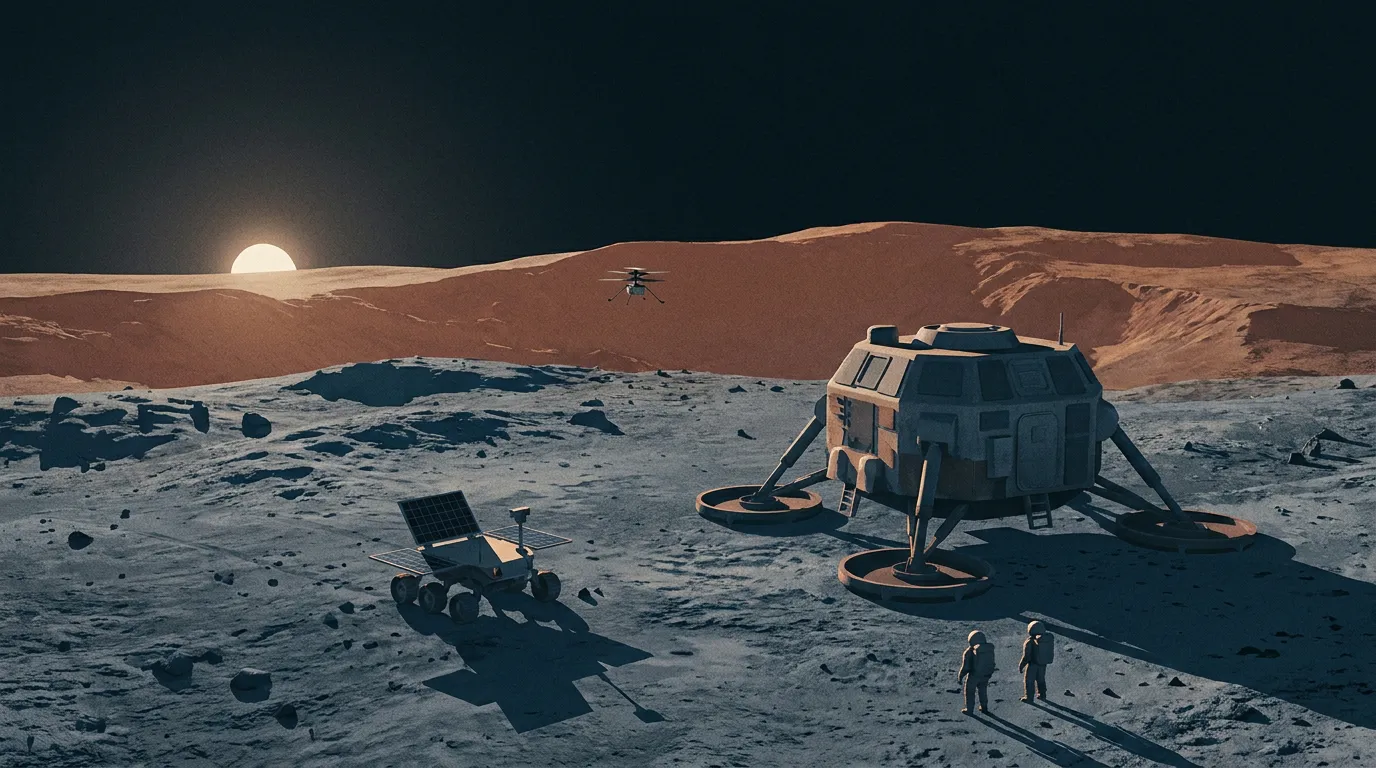
Senior NASA officials spent more than 90 minutes at a news conference last weekend laying out lunar contract awards, new contract opportunities and mission decisions, Ars Technica reports. The announcements came one after another. They covered landers, nuclear-powered rovers, scouting drones, power generation, storage and communication satellites.
Carlos García-Galán, manager of the Moon Base Program, said NASA hopes it is keeping industry "on their toes" as companies try to keep up with the solicitations. "This is what it takes to do the Moon Base in the timeline we have set forth," he said. Ars Technica's headline suggests procurement reform may be NASA's real advantage in the lunar race.
Source: Ars Technica
Road to Mars
Curiosity wraps up drilling at Nazca and studies chip-shaped crystals
Curiosity finished its drill campaign at the Nazca drill hole this week, a NASA rover blog reports. The bedrock there holds disk-shaped crystal forms, and the team wanted to characterise them better. Drill samples went to the SAM instrument while ChemCam, Mastcam and other instruments examined nearby targets. Imaging of Phobos eclipsing the Sun was prioritised, and a drive away from the site was planned.
Hera begins close inspections of the asteroid NASA rammed
Europe's Hera spacecraft has started close inspections of an asteroid that NASA rammed four years ago in a planetary defense test, Phys.org reports.
Anduril demonstrates a satellite sensor that works in Earth's shadow
Anduril Industries says its self-funded demonstration satellite, Anduril-216, has worked as intended. It carries a long-wave infrared sensor meant to detect other objects in orbit, plus an edge-compute processor and a power-management system. It launched in July on a SpaceX rideshare and flies about 590 km up, spending about one-third of each orbit in darkness, Ars Technica reports.
Senate committee to advance NASA finance and watchdog nominees
A Senate committee is set to advance the nominations for NASA's chief financial officer and its inspector general, SpaceNews reports.
The Lab
Bennu and the Murchison meteorite may share a chemistry but not an origin
Samples from the asteroid Bennu and the Murchison meteorite, which fell to Earth in 1969, both contain molecules that build proteins. New research finds that the molecules may have formed through the same process yet originated far from one another in the solar system, Phys.org reports.
Argon-40 on Uranus and Neptune may point to how the planets formed
Researchers led by Southwest Research Institute measured atmospheric argon-40 on Uranus and Neptune to estimate how much rock lies beneath their surfaces. The work, published in The Planetary Science Journal, also looks for clues to where and how the ice giants formed, and whether ice or rock dominates their interiors.
Sound Money
A Delving Bitcoin write-up asks how decentralized mining pools can scale payouts
A post on Delving Bitcoin opens a discussion on decentralized coinbase payout protocols. It says paying each participating miner with a distinct coinbase output does not scale. It also describes the "rich list attack," in which a large miner splits into several identities, takes extra payout slots and pushes the smallest miners out of the coinbase.
Russia's central bank sets Nov. 22 for exchanges to open crypto trading
The Bank of Russia said exchanges may start organized crypto trading on Nov. 22, once it has approved their trading rules, Bitcoin Magazine reports. Moscow Exchange plans to offer bitcoin, ether and USDT from Dec. 1. Separately, non-qualified investors may buy those three assets from Nov. 17, up to 300,000 rubles a year through a single intermediary.
Deutsche Bank turns on bitcoin custody for institutional clients
Deutsche Bank said Wednesday that its digital asset custody service is live for paying clients, Bitcoin Magazine reports. Institutions and corporations can hold bitcoin and ether, along with the USDC, EURC and EURAU stablecoins. The bank manages the wallets and private keys, and clients can store assets and transfer them to third parties.
Watch

RedPlanetLive - David Brin, Ph.D.
Red Planet Live · Oct 14, 2026

2026 Mars Society Convention - Day 3
The Mars Society · Oct 25, 2026

RedPlanetLive - Flashline Crew 19: Mars in the Arctic
Red Planet Live · Sep 16, 2026
The Marscoin Ledger
Marscoin ran slightly ahead of schedule, with five long waits
The chain produced 725 blocks in the last day against 702 expected, and now stands at block 3,600,123. Five waits ran longer than 30 minutes, the longest 57 minutes. Marscoin's price is $0.0613. The swap market has three offers on the book, together offering 401.8 MARS. Electrum-Mars v4.4.5 was published on November 10.