A public health page for the Marscoin chain
The Marscoin explorer has a new page: explore.marscoin.org/health. It answers three questions with data from the chain itself, refreshed every five minutes:
- How steadily do blocks arrive?
- How long are the waits when they do not?
- Who is mining them?
We built it because the answers matter to anyone who uses Marscoin, and because the honest answer today is “not steadily enough”.
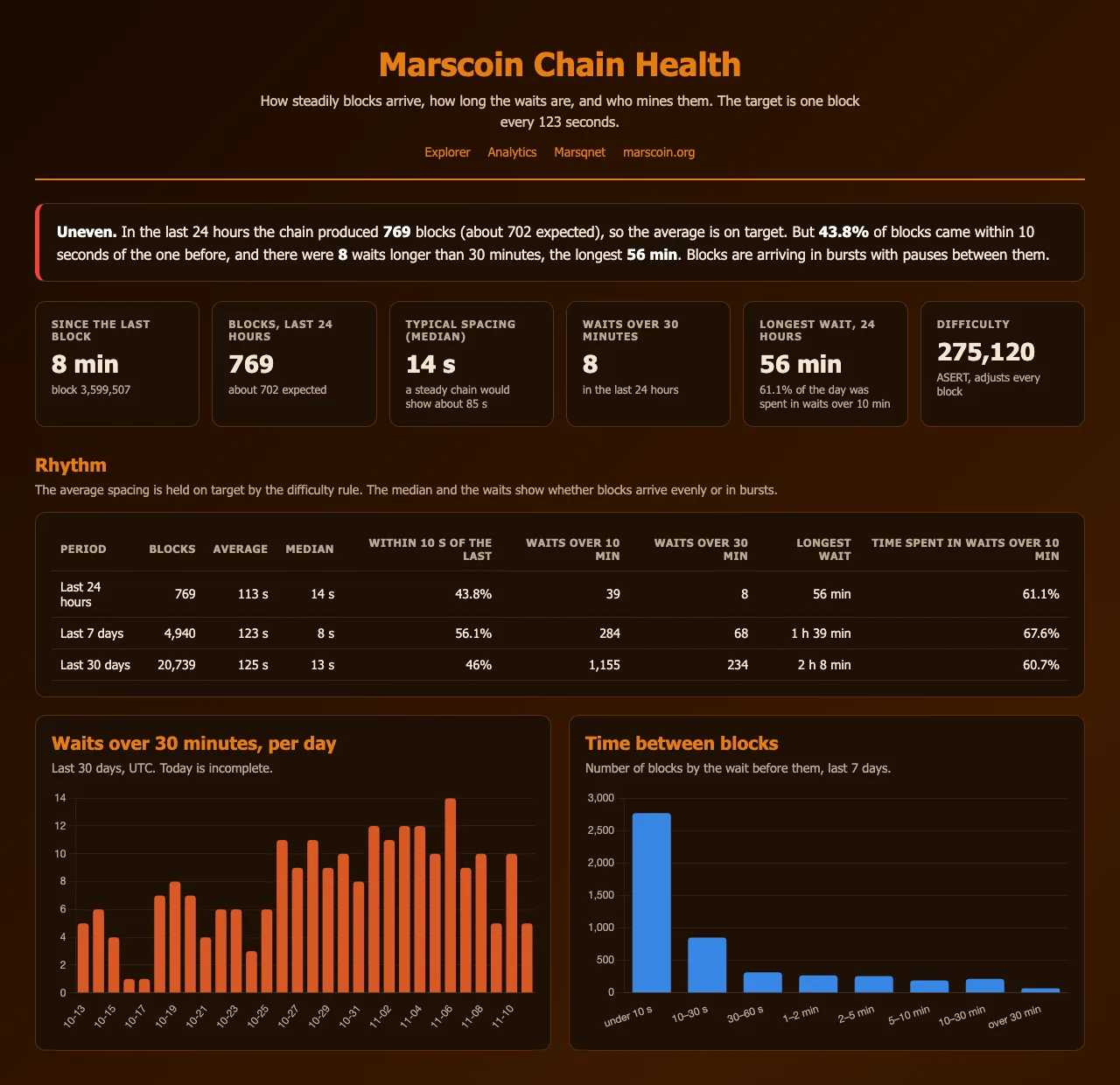
What the page shows today
Marscoin aims for one block every 123 seconds. Over a day, a week or a month, it gets there: in the last 30 days the chain produced 20,739 blocks at an average of 125 seconds each.
The average hides the rhythm. On November 11, 2026:
| Last 24 hours | Last 7 days | Last 30 days | |
|---|---|---|---|
| Blocks | 769 | 4,940 | 20,739 |
| Average spacing | 113 s | 123 s | 125 s |
| Median spacing | 14 s | 8 s | 13 s |
| Waits over 30 minutes | 8 | 68 | 234 |
| Longest wait | 56 min | 1 h 39 min | 2 h 8 min |
Half of all blocks arrive within a few seconds of the one before. Then the chain pauses, sometimes for the better part of an hour. If you send a payment or start a swap during a pause, you wait.
Why it happens
Marscoin is merge-mined with Litecoin. A Litecoin miner can secure Marscoin at the same time, with the same hardware and electricity, by adding one more job to their pool software.
Much of the world’s Scrypt hashpower is not fixed in place. It moves between coins and pools with profitability and market conditions, hour by hour. When most of a small chain’s blocks come from hashpower like that, blocks pour in while it is pointed our way and stop when it moves on. Nobody is doing anything wrong, and it is not specific to Marscoin.
The difficulty rule (ASERT, which adjusts after every block) keeps the long-run average on target, which is exactly what it was designed to do. It cannot make part-time hashpower look like full-time hashpower. Only miners who stay connected can do that.
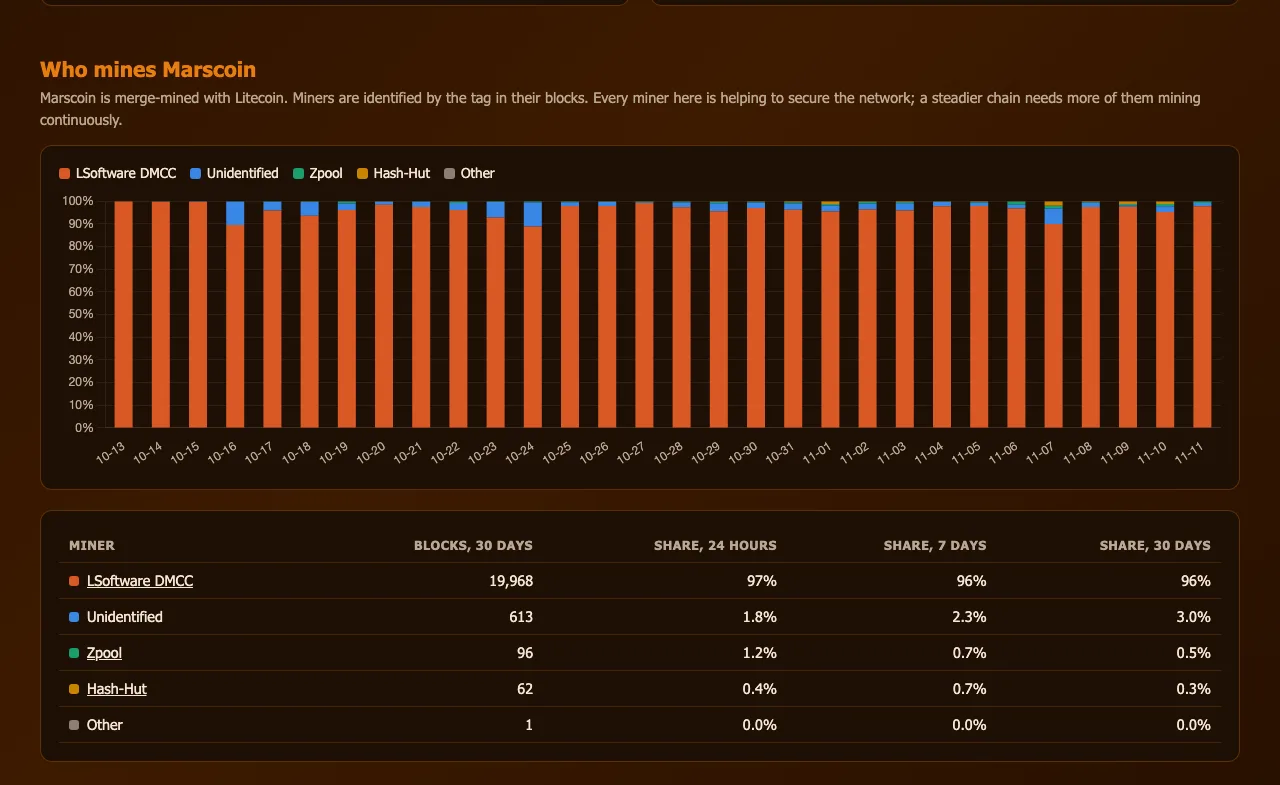
Every miner on that chart is helping. Without them there would be no blocks at all, and we are grateful to each one. What the chain needs is more of them, mining all the time.
What we are doing about it
- Asking. We have written to miners already on the chain and to several public Litecoin pools, and the first answers have come back. The conversation is open.
- Being upfront about the reward. Marscoin’s block reward is small. For a Litecoin pool, adding Marscoin costs almost nothing and earns little. The reason to do it is to support an open project with a long history and a clear purpose. We say so in every note we send.
- Giving credit. Pools that mine Marscoin appear by name on the health page, with a link. We will name them in our announcements too.
- Looking at the protocol. We are studying changes for a future network upgrade that would make block production less dependent on any one group of miners. Nothing is decided, and anything that changes the rules will be published and discussed first.
Start mining Marscoin
A small amount of hashpower that never leaves does more for the rhythm of the chain than a large amount that comes and goes. There are three ways in.
You have Scrypt miners
Point them at a pool that already merge-mines Marscoin. You keep earning Litecoin (and Dogecoin) as before, and Marscoin is added on top.
- Zpool and Hash-Hut both list Marscoin, and both appear on the health page today.
- miningpoolstats.stream/marscoin keeps a current list of pools.
You will need a Marscoin address to be paid to. The wallets page has one for every platform.
You run a pool
Marscoin is a standard AuxPoW chain, like the others you already merge-mine alongside Litecoin.
| Algorithm | Scrypt, merge-mined (AuxPoW) |
| Chain ID | 0x029c |
| Block target | 123 seconds, difficulty adjusts every block (ASERT) |
| Node | Marscoin Core 28.1 |
| Mining calls | createauxblock, submitauxblock, getauxblock |
| Network port | 8338 |
Run a Marscoin Core node next to your Litecoin node, add it as an auxiliary chain in your pool software, and include it in every job instead of only some. That is the whole change.
You want to help and are not sure how
Come and ask in the Marscoin Discord, where the community is around most of the day, or write to [email protected]. We can give you a dedicated node to connect to, help with configuration and test alongside you until your first block appears on the health page with your name on it.
If you use Marscoin
Before you send a payment or start a swap, glance at the page. The first tile shows how long ago the last block arrived. Your coins are safe either way: a pause delays a confirmation, it does not put anything at risk.
The page will keep score in public. When the chart of long waits starts to fall, you will see it there first.
Cite this page
Marscoin Foundation. “A public health page for the Marscoin chain.” Marscoin News, November 11, 2026. https://www.marscoin.org/news/chain-health-page-2026/