Merged Mining & AuxPoW
A technical explanation of merged mining (Auxiliary Proof of Work) on Marscoin — how it works, why it was activated at block 3,145,555, and the bridge strategy that uses Litecoin's hash power to secure Mars-bound infrastructure.
The Security Problem for Small Chains
Every Proof of Work blockchain derives its security from hash power. The more computational work required to produce an alternative chain history, the more expensive a 51% attack becomes. For Bitcoin, with its hundreds of exahashes per second, the cost of an attack is measured in billions of dollars worth of hardware and electricity. For a small chain like Marscoin — which shares the Scrypt algorithm with Litecoin but commands a tiny fraction of the global Scrypt hash rate — the calculus is far less favorable.
Before merged mining, Marscoin’s network hash rate was measured in single-digit gigahashes per second. A well-funded attacker, or even a medium-sized Litecoin pool temporarily redirecting hash power, could have mounted a reorganization attack. The chain was secure against casual attackers but vulnerable to determined ones.
This is the fundamental security challenge facing any small Proof of Work chain, and it is the problem that merged mining was designed to solve.
What Merged Mining Is
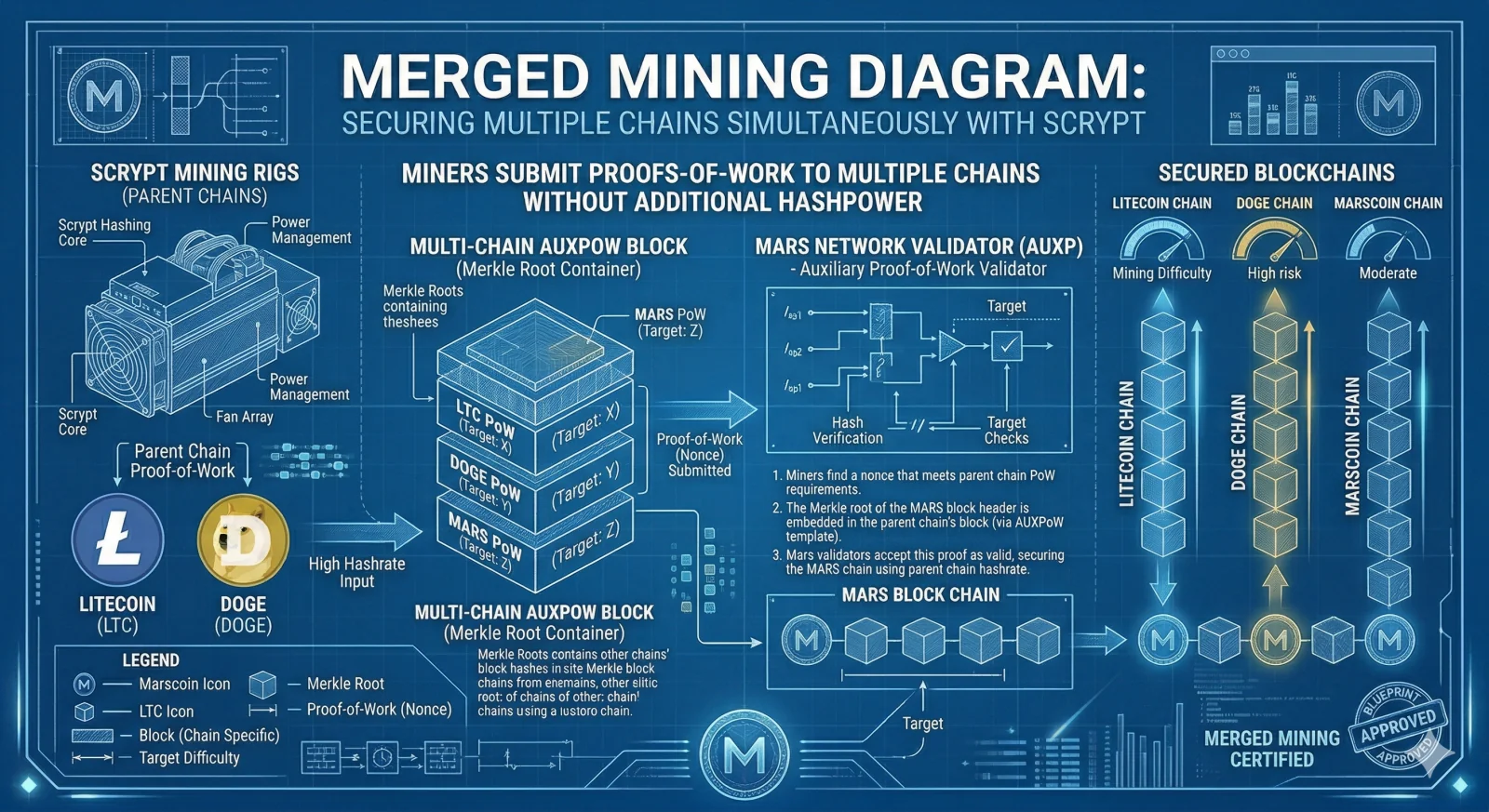
Merged mining — formally known as Auxiliary Proof of Work (AuxPoW) — allows a miner to submit the same proof of work to multiple blockchains simultaneously. The miner performs work for a parent chain (in Marscoin’s case, Litecoin or any Scrypt chain) and, without additional computation, submits that proof to one or more auxiliary chains (Marscoin and potentially others).
The key insight: the proof of work is algorithm-specific, not chain-specific. A valid Scrypt hash that meets Litecoin’s difficulty target also constitutes valid work. If that same hash also meets Marscoin’s difficulty target, it can serve as a valid Marscoin block proof. The miner does the work once and gets credit on both chains.
This is not a theoretical construction. Merged mining was first implemented by Namecoin in 2011, which merged with Bitcoin’s SHA-256 mining. It has been running continuously for over 14 years, securing Namecoin with Bitcoin’s hash power. The concept is well-proven.
How AuxPoW Works Technically
The technical implementation of AuxPoW involves modifications to both the block header format and the consensus validation rules.
The Parent Chain (Litecoin)
The parent chain miner constructs a normal Litecoin block, but includes an additional piece of data in the coinbase transaction: a merge-mining header containing the hash of the auxiliary chain’s block header. This is stored in the coinbase transaction’s scriptSig field, which Litecoin’s consensus rules treat as arbitrary data.
From Litecoin’s perspective, this is invisible — the coinbase data does not affect Litecoin block validity. The parent chain is entirely unaware that merged mining is occurring.
The Auxiliary Chain (Marscoin)
When a valid Litecoin block is found, the miner extracts several pieces of evidence and submits them to the Marscoin network as an AuxPoW block:
- The Marscoin block header — containing Marscoin-specific data (transactions, previous block hash, etc.)
- The parent chain block header — the Litecoin block header
- The coinbase transaction — proving that the Marscoin block hash was committed to in the parent block
- A Merkle branch — proving that the coinbase transaction is included in the parent block’s Merkle tree
Marscoin nodes validate this evidence by verifying that:
- The parent block header hashes to a value that meets Marscoin’s current difficulty target
- The coinbase transaction contains the Marscoin block hash
- The Merkle branch correctly connects the coinbase transaction to the parent block header’s Merkle root
If all checks pass, the AuxPoW block is accepted as a valid Marscoin block. The proof of work performed for Litecoin has been “recycled” to secure Marscoin.
The Efficiency Guarantee
The critical property of merged mining is that no additional energy is consumed. The parent chain miner is already performing Scrypt computations to mine Litecoin. Including the Marscoin merge-mining header in the coinbase transaction is computationally trivial — it adds a few bytes of data. The miner’s electricity bill does not increase. The hash rate is not divided. Litecoin’s security is not diminished. The same proof of work secures both chains simultaneously.
Marscoin’s AuxPoW Activation
Merged mining was activated on the Marscoin network at block 3,145,555 on February 14, 2025, following extensive testing and a coordinated upgrade process.
The Activation Process
- Code development: AuxPoW consensus rules were implemented in Marscoin Core, following the well-tested Namecoin and Dogecoin implementations as references.
- Testnet validation: The new consensus rules were tested on a private testnet with simulated merged mining loads.
- Node upgrade coordination: Major node operators, exchanges (LBank, Dex-Trade), and wallet providers were notified and upgraded in advance.
- Block height activation: The new rules activated automatically at block 3,145,555. Blocks after this height can be either standard PoW blocks or AuxPoW blocks — the protocol accepts both.
The Longpool Partnership
The primary merged mining pool for Marscoin is Longpool, which operates Scrypt merged mining for multiple auxiliary chains. Longpool integrates Marscoin into its existing Litecoin mining operation, allowing all participating miners to simultaneously earn Litecoin, Dogecoin, Marscoin, and other supported Scrypt chains.
Through this partnership, Marscoin’s effective network hash rate increased from single-digit GH/s to approximately 2 TH/s — an improvement of roughly three orders of magnitude. This level of hash power makes a 51% attack extraordinarily expensive, approaching the cost of attacking a significant fraction of the Litecoin network itself.
The Bridge Strategy
Merged mining is not Marscoin’s permanent security model. It is explicitly understood as a bridge strategy — a practical solution for the current Earth-based phase that will be superseded when circumstances change.
Phase 1: Earth (Current)
During this phase, Marscoin is a small chain operating on Earth alongside vastly larger Scrypt chains. Independent mining cannot provide adequate security. Merged mining borrows that security from Litecoin’s enormous hash power at zero additional energy cost.
This is the optimal strategy for the current phase. It maximizes security while minimizing the economic demands on the Marscoin ecosystem.
Phase 2: Transition (Pre-Settlement)
As Mars settlement approaches and Marscoin’s role shifts from experimental testbed to operational infrastructure, the protocol parameters will be finalized and hardened. Merged mining continues to provide security, but the community begins planning for independence.
During this phase, the key questions are:
- What mining algorithm should Mars-phase Marscoin use? (RandomX is the leading candidate)
- What minimum hash rate is required for adequate security in a Mars-only network?
- How will the transition from merged mining to independent mining be coordinated?
Phase 3: Mars (Post-Settlement)
Once computing infrastructure exists on Mars, Marscoin transitions to independent mining. This transition is not optional — it is physically necessary. The 4-to-24-minute light-speed delay between Earth and Mars makes merged mining with Earth-based parent chains impractical. A miner on Mars would always be minutes behind the parent chain tip, unable to construct valid merge-mined blocks in real time.
On Mars, Marscoin will need its own dedicated hash power. The settlement’s general-purpose computers will likely serve as mining nodes, running a CPU-friendly algorithm like RandomX. The hash rate will be small by Earth standards but sufficient for a local network where the threat model is fundamentally different — there are no external miners with massive hash power to mount attacks.
Security Analysis
Before AuxPoW
| Metric | Value |
|---|---|
| Network hash rate | ~5 GH/s |
| Estimated 51% attack cost | Low (accessible to mid-size mining operations) |
| Block time stability | Poor (oscillating difficulty) |
| Theoretical attacker profile | Any entity with >5 GH/s of Scrypt capacity |
After AuxPoW
| Metric | Value |
|---|---|
| Network hash rate | ~2 TH/s (via merged mining) |
| Estimated 51% attack cost | Very high (comparable to attacking Litecoin) |
| Block time stability | Excellent (ASERT + merged mining) |
| Theoretical attacker profile | Only entities capable of dominating Litecoin mining |
The security improvement is not incremental — it is a qualitative transformation. Marscoin moved from “attackable by a motivated individual” to “attackable only by a state-level actor willing to simultaneously compromise Litecoin.”
Merged Mining and ASERT
The combination of merged mining and the ASERT difficulty algorithm is synergistic. Merged mining introduces large and rapid fluctuations in effective hash power — as Litecoin pools add or drop Marscoin as an auxiliary chain, the hash rate can change by orders of magnitude within minutes.
ASERT handles this gracefully because it adjusts difficulty every single block based on elapsed time, not on a moving average of recent blocks. When a large pool begins merged mining, difficulty rises immediately. When it stops, difficulty drops immediately. There is no lag, no oscillation, and no sustained period of either too-fast or too-slow blocks.
Without ASERT, merged mining would have been far more disruptive. The legacy windowed difficulty algorithm would have produced severe oscillation as merged mining pools came and went. ASERT was, in a very real sense, a prerequisite for merged mining.
Conclusion
Merged mining is the pragmatic answer to a genuine security challenge. It provides Marscoin with hash-power protection far beyond what its independent economy could sustain, at zero additional energy cost, while preserving full sovereignty over the protocol’s consensus rules and monetary policy.
It is a bridge — and bridges are meant to be crossed.
AuxPoW was activated on Marscoin at block 3,145,555 in February 2025. Merged mining is supported through Longpool and compatible Scrypt mining pools. For instructions on setting up merged mining, see the Mining Guide.